books, reading

Love of Libraries

I am a great supporter of my local library.  Over the last 5 years 80 – 90% of the books I have read have come from the library.  I have not purchased a book in a number of years. I had NO idea what happened to prices.  Today, I went in to a bookstore, found the book I wanted, and went to the register.  Much to my surprise one paperback book came to $18.  Now, I am lucky enough to be able to purchase this without much concern, but holy cow!  At these prices there is a large number of people that would not be able to do so.  Which leads me back to the idea of the library.

My public library’s name is actually “Free Library”.  Back in the day, only those that could afford a subscription to a library were allowed to borrow books.  That, however, is not true any longer.  Although people can forget these places as a resource, the doors are open, both virtual and real, in order to give you access to the world via media formats (book, ebook, audiobook, video, etc.)

Back in the 1970s there was an episode of “Happy Days” when the Fonz got a library card.  After that there was a significant jump in new library card requests. How much of the country, or world, does not know what is available to them at no cost? How many worlds would this open up for people who see nothing but pain, obstacles and despair?  And with the fragmentation of media, where would this type of thing be most prominent?  Maybe the Kardashian family should take the kids to the library instead of a fashion show – watch how many other families would do the same.

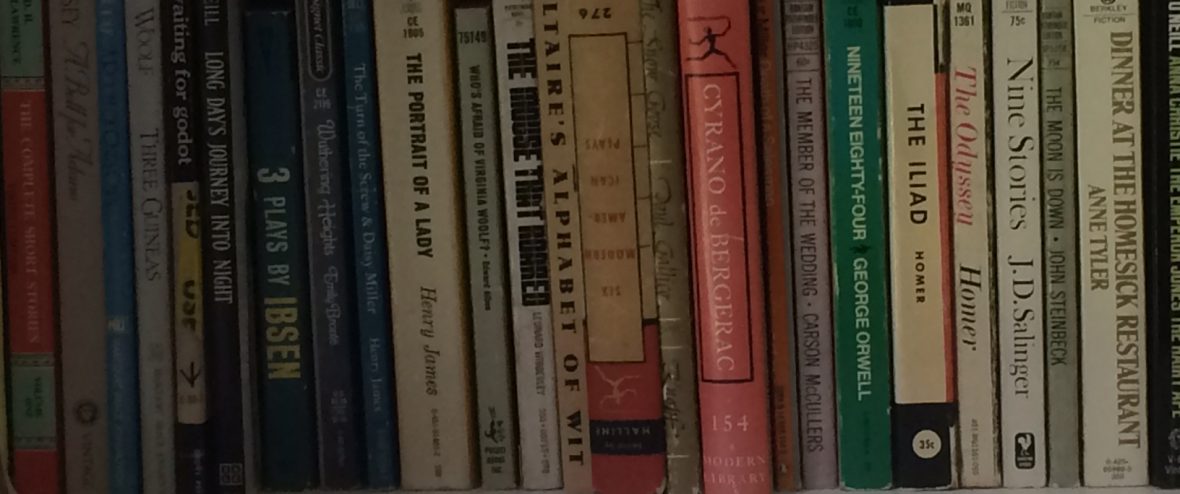
Back to the free library – I have loved them since I was first introduced to them as a child.  Reading, of course, was highly valued in my family.  My sisters and I all worked at the public library throughout high school, and I even worked in one throughout college.  To me, these are safe, happy places where I can find a million different ways to solve a problem, change a mood, or lend an empathetic ear to characters, and myself.  And although I no longer own the books that I have borrowed, I am happy to send them off into the world to touch others.  The books I keep are a reflection of who I am and how I got here. I know that there will never be enough bookcases to hold all of my books.  And I have books for me, my kids and books my kids outgrew that I am saving for grandkids.  The goal is to have Grandma’s house be a lending library, too.  Just as long as it doesn’t have to open any time soon!

books, reading

Picking titles to send to camp

When on earth did it get to be June?  Now I not only need to choose books for me, but for the kids to take to camp.  This is my opportunity to try to influence their love of learning new things and of trying something else.  See, the camps my kids go to are sleepover camps, with no electronics allowed except MP3 players with no video and “quite” time each day when they are encouraged to read. The beauty of this is many layered, but the stress of finding something appropriate, and not embarrassing to the teens I am sending, places that bar very high on stress to get this right.

So, how do I get my kids to read things that are important, impactful, and not embarrassing?  I trick them.

Last summer my daughter was preparing to enter high school.  I am aware of the things they are surrounded with, and the temptations that are there.  Without being too preachy about the perils of drugs, I selected Go Ask Alice for her.  She was thrilled that it was a grownup theme that she could relate to, and that was still relevant in this world. I know I read this in high school, myself, and I still remember some scenes vividly.  It opened a conversation for us, which had been my goal.

My son, however, was going through an “I hate reading” phase, so I found as many I Too Funny books and comics to send as I could.  My belief is that I don’t care what you are reading, just read.  And sometimes I need breaks from the heavy reads too.

I digress, however.  I am now struggling with what to send, and what to tell Grandma to send as packages.  My boy, now 13, loves fantasy and action.  A friend of his read The DiVinci Code, so he read it too, surprising himself by enjoying it.  Based upon that, my mind went right to Tom Clancy.  My boy will be receiving The Hunt for Red October from my parents within the first week of camp.  I am thinking along the lines of The Last Days of Summer, by Steven Kluger.  An entertaining story of a fatherless boy reaching out to the all star 3rd baseman of the NY Giants, as told from the letters to each other.  This story of persistence and generosity, all with a sense of humor, can teach about how you can learn from each other and how important it is to choose who you rely on.

My daughter, however, will be getting Speak from Grandma. Since this content is hard, I am hoping that getting it from Grandma will help.  Regardless of how strong she thinks she is, and how far the world has come, the violence against women and girls remains a fact.  Just read the headlines.  Learning when and how to speak for yourself is a lesson we all need to be reminded of.  So that means something a bit lighter from me, just to balance off.  That leads me to any one of the following (still not sure which to choose): Anna and the French Kiss, The Help, Just one Day, Since You’ve Been Gone  or Cinder.

Please comment with any suggestions you may have.  If not now, there are plenty of opportunities to put them around the house to be picked up….

books, reading

Philip Roth’s Impact Remains

With the passing of Philip Roth this past week, I was struck by how much I remembered from his work, specifically Portnoy’s Complaint. It is just by chance that this past week I read a book that was reminding me of this book, but was nowhere as well done as the original.  In the original, Roth’s central character speaks to his psychoanalyst, describing his life as a series of conquests, but no meaning or destiny.  The book explores sexuality, assimilation, Israel and the concept of a Jewish family.

All these traits are also examined in Howard Jacobson’s prize winning novel The Finkler Question.  The central character Julien Treslove takes a similar tale, but from a different vantage point.  Where Portnoy is Jewish, Treslove is not.  And while there is no psychoanalyst bearing witness, it is two friends from school who are.  On his way home from a dinner reminiscing with Finkler and Libor, Julien is mugged. The woman that takes his belongings is believed to say “You, Ju.”   As he ruminates on this, we are given a glimpse into the obsession he has on Jewishness, or what he calls Finklerness.  Just as in Roth’s book, we are then given the history of Julien’s conquests (or failures as they all left him), the concern of assimilation, the question of our right to judge Israelis, and ultimately, what is a family.

While Jacobson’s work had very interesting takes on the question of Jewish identity, he is not Phillip Roth.  While the work was well written, at times it seemed overwrought and a bit long winded.  Roth had been able to alleviate the banality of the story at times with a dry wit, but the Jacobson book was missing that key ingredient. Intentional or not, these parallels were plain for me to see – and I started the book before news of Roth’s passing had been announced.

It is this “coincidence” that pushed me to look more deeply into the parallels of these books.  I am now more impressed with the Jacobson book, as I view it as a nod to the greatness of the plot and structure of Portnoy’s Complaint.    And more impressed with Roth, since the work is still so relevant to have inspired me to make these types of connections with a book written so much later than the original.

book-review, books, literature, Middle Eastern, read around the world, reading

Women’s Rights in the 21st Century as illuminated in novels and memoirs

2017

A “watershed” year for women. Accusations of sexual misconduct by studio heads, actors, musicians, politicians and others have been in the headlines, and the #MeToo movement continues to move forward.  Ashley Judd is suing Harvey Weinstein for career sabotage.  House of Cards folds.  Bill Cosby is found guilty.  All of these are an affirmation of women and the power they hold.

Contrast that to the women in Middle East countries run by fundamentalist regimes – Saudi Arabia, Iran, Iraq, Afghanistan, and more.  While women in the western world are fighting for equal pay, equal access and job safety, the women in these other countries are looking for basic human rights.  While the struggle is real in western culture, it is life threatening for those behind the Burqa curtain.

Afghani women still commonly wear these Burqa to hide themselves from men, because the world there is still ruled by them.  In The Pearl that Broke its Shell by Nadia Hashimi, two stories, a century apart, are told of women facing a similar challenge.  In one, a father who has spent his life fighting for freedom of his country becomes addicted to the opium it provides.  In the other, a father spent his life fighting for freedom to cultivate his own land apart from his family.  In both scenarios only daughters are available to assist, and each father chooses to blind themselves as these girls take on traditionally male roles of helping, as is available to Afghani’s.  At the age of puberty, however, these girls must revert to traditional roles.  Within this book the two tales intertwine and support each other, with the older story helping to lead the way for the newer story.  In both tales, beatings were the norm.  The brutal handling of women for the slightest of perceived infraction occurs not only at the hands of men, but also of women in the attempt to exert what little power they have over their own worlds.

As the dawn of women in parliament is achieved, the reality of who is in power, the husband’s, remains real.  The access to news and learning continue to keep women in the dark of what they can achieve elsewhere, and that there are other options for them.

The facts of this echo in my head of And the Mountains Echoed and I am Malala.  Extreme violence against women remains a great threat to us all.  Hollywood’s brutality may be less physical, but it is no less demeaning or scarring.  In this light, how many of us can again echo #metoo? I know that, despite the promotions I have missed, the comments and looks I have endured, and the ceiling I have over my head, I am significantly more “free” than the women portrayed in the novels, or in the memoir mentioned.  There are so many more of these stories – remember Not Without My Daughter?

In the beautifully written and translated The Palace Walk series, the closed windows and doors of the home serve as a metaphor of how Egypt was closed from the world at the beginning of the 20th century.  As the world comes into the home, changes begin to emerge within.  This is true in The Pearl the Broke its Shell – thus the reason the TV is removed from the rooms when the women come to Kabul.  By trying to keep the walls up, and the world hidden, the power remains in the hands of those that have both the knowledge and the brute strength.  As women are allowed to see freedoms, even if to serve as a bacha posh, an ancient practice were young girls dressing as a boy before they mature in order to perform duties for the family that only a boy can do, it is hard to return to the ways of women.  If knowledge and access to others were allowed, the iron grip would weaken.  As it has in the west, women have sought so many more opportunities as they push through the doors, break down walls and crack the ceilings.  We just can’t forget those that have not even been allowed to see beyond their own courtyard.  Until all women are free to learn and choose, none of us are free.  So while #metoo is relevant, we have so many more greater battles to fight for our sisters.

books, reading

Mother’s Day

What is the important gift you have received from a mother figure in your life?

I have just completed reading a collection of essays What My Mother Gave Me: Thirty one women on the gifts that matter most.  As I read through these, some stories are so sad, while others resonate with me in surprising ways.

Karen Karbo’s essay, titled White Gloves and Party Manners, immediately brought a smile to my face.  See, my mom had purchased this book for her daughters.  In fact, as I was clearing out some books from my parent’s home, I took this for my teenage daughter, whom I am sure has not looked at it.  It gave me hope, however, that there will be a time when she will look to that book, and if not read it as a bible, at least smile that I cared to give it to her.

In Abigail Pogrebin’s essay, Never Too Late, she explains how as an adult she chose to have a bat mitzvah. She briefly described her mother’s conflicting relationship with the religion and how this led her to not pass on traditions and the difficulty of that choice.  This hit close to home. While I have strong opinions of a woman’s place in the world, in every religion a woman is treated as a second class citizen.  This has impacted me on what I want to pass on, and how, to my children.

The essay that impacted me the most, however, was The Broken Vase by Reverend Lillian Daniel.  In her mother’s collection of items from a life around the world, the one piece of pottery that she called “the most valuable piece of pottery in the house” was powerful.  Her father was coming home to them in Japan, with a gift of pottery for her mother.  As he approached the house, 4 year old Lillian ran to meet him, and in his excitement to catch her in his arms he dropped the vase.  Her mother took it and immediately glued it together as best she could.  It was always prominently displayed and reminded her of the love the two had.  She goes on that her mother always looked for the good in what was there, in all situations, even when the cooking was not as good as the presentation.  I will keep that in mind when I am doing holidays going forward, to try to take it all in stride.

As for the broken pottery, I myself have a teapot that fell and broke.  I had not used it in ages, but my grandmother had given me tea with this beautiful tea set when I came to visit with her.  She got out of her deathbed and packed it up for me the night before she passed.  This last essay let me remember that even though there is a small hole in the teapot, the love that brought it to me, and that I see whenever I look at it, will always remain unbroken.

Happy Mother’s Day.


books, reading

Curating books – aka keeping a handle on the hording

I was hoping to finish the novel I am reading now and do another book discussion, but was not able to complete in time for a weekly post.  Will work on that one for next week.  Instead, here is some insight to how I maintain my bookshelves.

My bookshelves, we have more than 7 in our home, are full of books:  waiting to be read and waiting to be re-read.  While I do believe in sharing books, there are some that I can never bear to part with.  Trying to explain that these pages are a reflection of who I am to non-readers can produce many funny looks.  Especially if you live with someone who believes that print is dead.

Sacrilege I say!

For those with small children, I understand how overrun the house can get with books – it’s so easy to get just a few more.  The key is that you need to “cull” those books wisely.  I am a firm believer in the “PILED” method:

Preserve the books that mean most to you.  They can be books that were given to you by a special person, or have been passed to you.  The meaning in the book is associated with the physical book itself.

These are the books that have touched you and become part of who you are.  The characters, the place, the experiences have all helped shape you and how you approach the world.

These are the first additions, investment books.

These are the books that you want people to see on your bookcase.  These project the image of who you want to be known as.

Identify books you liked, and are ok to let go. These are the books that I trade with my family and friends.  If I liked it enough to share, you can know that I enjoyed it, but didn’t LOVE it enough to keep it. It is always a good rule of thumb to understand when you pass these out, odds are you will never see them again.  If that works for you, by all means, share.

Love those books that you will want to pull out again. These are books that you love and want to share with your family, but maybe not now.  For example, Sandra Boynton books are some of the best children’s literature, up through the toddler years.  The need, however, to read this nightly (or constantly) to a budding high schooler is not the same.  It goes the other way, also.  My toddler didn’t need to have my paperback copy of Frank Herbert’s Dune, which I acquired in 7th grade, on her bookcase at 18 months.  Both sets have been stored in plastic boxes, and are circulated at the appropriate age.  The favorites that we have outgrown have been saved for my grandchildren, may they please not come anytime soon.

Eject those books you hated. These are the books that you hated the characters, the plot, the pacing, the language, any or all of the above.  These tend to be the books I gift to libraries.  My name will not be used to tacitly endorse a book if it is coming from my house.  There has been a RARE occasion when I just couldn’t handle it anymore, and it just had to be thrown out.  I have only done this once in my life so far.

Damaged books should be given a good retirement – these are the books whose conditions render them unreadable.  Either through being too well loved (my book Dune has its cover just come off) or ruined (fell in the tub when reading), these are not to be shared with others.   It is up to you to decide if this title was important enough to either mend the book or re-purchase.  Either way, once the decision is made, the old books should be thrown away to make more room for new ones.

I do this exercise in earnest each summer, when the kids are away at camp and I can focus.  On a smaller scale, I do this as I determine what bookshelf a book will be placed.  The ones in the family room, the ones in the “library” space we created upstairs near the bedrooms, or the one by my bed.  And these always end up in a different place when I am done.  In my home, the written word walks among the family.

books, reading

How do you let go of the world you live in and move on? Or How to choose the next book you will read

Leaving behind a world when you put down a book can be hard.  You have been invested in these people’s lives, and now the story is over – if you want it to be or not.  Sometimes there are other ways to continue (the next book in the series), and sometimes there are not.  Either way, you need to re-enter your own reality, and then decide how to move on.

If you are anything like me, you become fully vested and are impacted by the people we visit in our books.  When I finish a book I need some time to process what I have just experienced and re-enter my own world.  Some books need more processing than others.  A Walk Across the Sun by Corban Addison, an amazingly written and compelling story about a very difficult topic, left me stunned for days after.  Even now, months later, I am impacted by the story.  Other books do not leave as deep an imprint upon me, and are easier to move on from.

So, how then do we choose our next book?  As always, that depends.  I have been challenged to find the “perfect” answer and have tried different ways, all with hit or miss results.  Here are some of the ways I have tried.

I maintain lists of books that have been recommended to me either directly or from another source, such as Princeton Book Review, Wall Street Journal, and even Buzzfeed Books.  I keep these with information on the book in the list, and see what hits me as interesting at that time.  It was from these sources that I found A Walk Across the Sun.

If you are part of a book group, you can easily use that as the next book to read.  If you finish that one in plenty of time, it can be great to read others by that author or on that topic to have a deeper discussion around the original book.  As a book group facilitator myself, I do this.  My group read Look for Me by Edeet Ravel. I didn’t realize when the book was selected that it was a second one in a trilogy.  I was so captivated by the writing and the mood this book I immediately went to read Ten Thousand Lovers, the first book.

I receive books from friends and family that they think I need to read.  I will pick these up when I have some open time and nothing that I am burning to read.  My mother-in-law keeps trying to give me her old books, but I have read most of them already.  My mother, who is currently a member of 3 book groups, also gives me books and book titles (she is another library user – that is where I got it from.)

I try different websites, and the Goodreads.com recommendations of IF YOU LIKED THIS BOOK YOU MIGHT ALSO LIKE…..  all with varying levels of success.

In short, like how you meet new people, you need to just put yourself out there and start the relationship in as many ways as possible, because you never know when you will meet “the one”.

books, reading

Graphic Novels: Complex themes/unorthodox medium – an examination in the similarities of Maus and Persepolis

This year I have been striving to be open to read different types of books than I normally would.  As part of a book group challenge on Goodreads.com, I started looking for illustrated books for adults.  What I found was so much more than comic books.

As I looked through titles, I noticed Maus, a book I had not heard of before.  My husband, and other East Coasters I spoke with had all read this in high school. I got this from the library (I am attempting to not spend money on a book this year, and our library is so amazing I want to support them), and started reading.  By the time I put the book down later that day, I was already itching to read the second one, which I did the next day.

A month later, my daughter asked me to proofread a paper for school on Persepolis, a graphic novel about the overthrow of the Shah in Iran in the late 1970s.  This time I requested BOTH volumes 1 and 2 at the same time.  That turned out to be a smart move.

In addition to both sets of graphic novels leaving me wanting more, there were striking similarities between these.  Both were autobiographical, dealing with war and oppression.  The dark themes of losing yourself, of exile from home, and of leaving behind pain are shown.  The method of the graphic novel, while making things seem “more casual” actually illuminate the history of two corrupt regimes very well.  Both periods in history show how brutal people can become in the quest for power.  The pictures help make the horrors easier to face.  There are no real faces or photos, creating a barrier for both the reader and the writer to get through the story. Maus goes so far as to depict Jews as mice, Germans as Cats and Poles as pigs, a further statement on the state of humankind.

Underpinning both stories of survival and self-discovery, both books exhibit the traits of survivor’s guilt.  Persepolis’ Marji had been able to escape the ravages of war and oppression as a displaced and lonely teenager in Vienna, but needed to return to her home before realizing she didn’t fit in there, either.  She was ultimately able to leave her country behind, but never her guilt of leaving.  It was only with the second departure that she understood that her mother, while loving her deeply, wanted Marji to live in a world where she could be more than was being allowed in Iran.

Within Maus, the survivorship takes on more layers.  Not only did he exist in the shadow of his dead brother who died in the war as did the majority of the family, but Art survived of his own mother’s suicide.  It was Art’s dealing with this guilt in an underground comic strip that lead him to ask his father’s story – to learn more of his mother.

As noted in Persepolis, it will take generations for the people to truly heal. Both stories show the evils of extremism and intolerance.  If we could all look at the world with the veil over our eyes to see only drawings, maybe we can see the complex truth in the simple lines.


books, literature, reading

My Journey Begins

Thanks for joining me!

“For one who reads, there is no limit to the number of lives that may be lived”  Louis L’Amour

My love with reading goes back to when I was a child.  I would lose myself in a book that made my world so much more fun and exciting.  I remember reading under the covers with flashlights and hiding books under my bed. In middle school, I was asked to run the student bookstore.  By the time I could get a “real” job, I was a page at our public library.  I continued to work at libraries throughout my college career.  The libraries, be them public or restricted, general or specialty, all called to me.  They were a safe place to be, full of friends and opportunities.

While I pursued a career outside of library science, my love of books and libraries has never waned.  I achieved a graduate degree at night school while I was working full time.  As graduation gifts my friends all gave me novels – the thing I missed most when I had homework.  I helped launch a book group for a non-profit organization, which I led for 3+ years before moving on.  I married and had children, bringing me back to books I loved.  My children loved to read with me.  They were in pre-school and kindergarten when they asked for a WII.  My husband and I decided they had to read 100 books together in order to earn this.  We didn’t care they were early readers or picture books, but they had to add the titles to the list on the fridge when they were done.  We have used this for other things too.

Then I turned 49.  A good friend asked me what I was going to do in my 50th year.  That got me thinking – what should I do?  That was when I created what I called the 50 for 50 challenge for myself.  I would read a best seller from the New York Times best seller list from the week of my birth for each year I have been alive, avoiding any re-reads and selecting from the top 10 (not necessarily the number one).

 Since that time I have continued to track my books, in excel.  I can look back and see if I have read something, and know how many I have read.  In the past few months people have begun to ask me for recommendations of books.  That made me think I should share my thoughts on titles I have read and want to read.  This is my journey – to share my love of reading with others so we can all be better people.

The blog title comes from The Source – James A Michener’s book.  This title that was number one on the New York Times Best Seller List on the day I was born.  I look forward to sharing this journey with you all.

Karen