books, reading

Back at it – 2019 has begun

Ending the year 2018 with a big historical biography has slowed me down. While it was an amazing book, Clara Barton was a complex individual with a spine of steel, and a depth I had not fully appreciated prior to reading this biography, the dense volume took much time to digest. I ended up taking the last week off before year end with no reading at all. All in all, the year of 2018 was a successful reading one for me. 2019 is looking to be another one.

This year I am continuing with the reading challenges that I found last year. These are right up my alley – one is reading about different cultures – and I am excited to see what I am going to mark off my personal around the world book challenge. The first challenge to be tackled by me, however, is from my TBR list – The Bookshop of Yesterdays.

The main character is named for Miranda in Shakespeare’s The Tempest, and the bookstore she inherits is Prospero Books. The story begins when Miranda hears that her Uncle Billy, whom she has not seen or heard from in 16 years, has died. Billy was known for his scavenger hunts – and he sent one to Miranda after his death. She returns from Philadelphia to California to find out what happened. Throughout the story, the mystery of why Billy disappeared on her 12th birthday is driving her forward to reveal the secrets her parents have kept from her. The parallels to The Tempest abound through the book, and I am sure I would have noticed more if I had actually read Shakespeare’s story. If you are familiar with the book, you will solve this much quicker than if you do not. Either way, the characters are engaging, if playing according to the rules of the original. All in all, this was a good read.


books, humor, reading

My Christmas morning

Twas the morning of Christmas, and all through the house

Not at creature was stirring, I hope there’s no mouse

I woke with a start, I started to panic

Did I do this or that, or did I just jam it?

So I crept down the stairs, quite as can be

To do more puzzles, a quiz, but nothing before coffee

The puppy remains upstairs in her bed,

With visions of car keys dancing in my girl’s head

The boy is out cold, with a clicker in hand

As he tries to win best fortnighter in the land

We unplugged last night to play Monopoly

When hubby and I ended our spending spree

All is peaceful for now, with everyone out

So soon they will wake and begin to shout

Today is the day when nothing is open

You know that means they need something this moment

With a mug in one hand, and a wish in my heart

That I remembered my glasses so I could read the next part

So I move to the keyboard, enlarging the font,

Wondering what next they will want

I write down my saga, however so sad

That I cant read without glasses – and that makes me mad

I can’t go back up and wake up my hubby

Or the dog will start barking and then in a hurry

They all will be up, my peace will be gone

The chores will begin and I’ll be forlorn

For these hours I cherish – you’ll find me if you look

Curled up on the couch, reading a new favorite book.

Merry Holidays to all!

books, reading

Year in Review – adding to the lists

account black and white business commerce
Photo by Pixabay on Pexels.com

The New Year is lapping at our toes. The press is already showing the lists of Best Books for the Year. I may not be done with my reading, but I will jump in the fray wrapping up lists and challenges for the year.

Goodreads has kindly informed me that as of today I have read 26,895 pages across 80 books so far this year, with my longest book coming in at 1376 pages (Noble House). Even though this is owned and operated by Barnes and Noble, the discussion groups have been a great source of titles and inspiration for me. One group ran monthly challenges in honor of its 10th anniversary year.  I chose books from member’s libraries, books on my TBR list, prize winners, buddy reads, and recommendations from members. While the time was well spent for myself, I was one of 13 that completed the full challenge with all possible points, and was entered to a raffle that many times – and won third prize.  I am now on the hunt for great titles to spend my gift cards on.

As I do that, here are some books you may be interested in – and how I challenged myself to read so widely.

List 1:  Books I read for the PBT Decatholon:

MONTH TITLE AUTHOR
September: The Chilbury Ladies’ Choir Jennifer Ryan
August: The Thirty Nine Steps John Buchan
July: The Hearts Invisible Furies John Boyne
June: Marley and Me John Grogan
May: The Finkler Question Howard Jacobson
April: Runaway Alice Munro
March: Maus 1: My father bleeds history Art Spiegelman
Maus 2: And here my troubles begin Art Spiegelman
The Little Prince Antoine de Saint-Exupery
February: An Invisible Thread Laura Schroff
January: Beartown Fredrik Backman


List 2: Books I read for my travel log: Around the world

COUNTRY TITLE AUTHOR
Saudi Arabia Girls of Riyadh Rajaa Alsanea
Afghanistan The Pearl That Broke Its Shell Nadia Hashimi
Chile Ten Women Marcela Serrano
China The Tea Girl of Hummingbird Lane Lisa See
Dominican Republic How the Garcia Girls Lost Their Accents Julia Alvarez
Ethiopia Life After Coffee Virginia Franken
France The Velvet Hours Alyson Richman
Hong Kong Noble House James Clavell
Iran: Persepolis: The Story of a Childhood Marjane Satrapi
Ireland The Heart’s Invisible Fury’s John Boyne
Kenya Circling the Sun Paula McLain
Korea Please take care of mom Kyong-suk Sin
New Guinea Euphoria Lily King
Pakistan I Am Malala: The Story of the Girl Who Stood Up for Education and Was Shot by the Taliban Malala Yousafzai
Peru The Bridge of San Luis Rey Thornton Wilder
Scotland Eleanor Oliphant Is Completely Fine Gail Honeyman
Singapore Crazy Rich Asians Kevin Kwan
Sweden Beartown Fredrik Backman
Turkey The Lost Sisterhood Anne Fortier
USA A Fall of Marigolds Susan Meissner

 List 3: My best reads of the year

Title Author
Girls of Riyadh Rajaa Alsanea
The Weight of Ink Rachel Kadish
Eleanor Oliphant Is Completely Fine Gail Honeyman
Before We Visit the Goddess Chitra Banerjee Divakaruni
The Most Beautiful Book in the World: Eight Novellas Eric-Emmanuel Schmitt
Faithful Alice Hoffman
The Pearl That Broke Its Shell Nadia Hashimi
The Hate U Give Angie Thomas
A Fall of Marigolds Susan Meissner
Beartown Fredrik Backman
The Rent Collector Camron Wright
The Chilbury Ladies’ Choir Jennifer    Ryan
Before We Were Yours Lisa Wingate

Last but not least, as I read through the Best Books lists of the year, my TBR list continues to expand.  Currently at 126, here is what I am working on:

List 4: To Be Read (TBR):

Title Author
No Turning Back: Life, Loss, and Hope in Wartime Syria Rania Abouzeid
The Labyrinth of the Spirits Carlos Ruiz Zafón
Unsheltered Barbara Kingsolver
Pretend I’m Dead Jen Beagin
Those Who Knew Idra Novey
Asymmetry Lisa Halliday
The Last Girl: My Story of Captivity, and My Fight Against the Islamic State Nadia Murad
Nine Perfect Strangers Liane Moriarty
We Should All Be Feminists Chimamanda Ngozi Adichie
Truth and Beauty Ann Patchett
Autobiography of a Face Lucy Grealy
Almost Everything: Notes on Hope Anne Lamott
Artemis Andy Weir
Good Night Stories for Rebel Girls: 100 Tales of Extraordinary Women Elena Favilli
In Search of Lost Books: The forgotten stories of eight mythical volumes Giorgio van Straten
Little Edward Carey
Night of Miracles Elizabeth Berg
White Houses Amy Bloom
Radio Free Vermont: A Fable of Resistance Bill McKibben
Alternate Side Anna Quindlen
The Diary of a Bookseller Shaun Bythell
Relic (Pendergast, #1) Douglas Preston
The Clockmaker’s Daughter Kate Morton
The 19th Wife David Ebershoff
Educated Tara Westover
The Library Book Susan Orlean
Codename Zero (The Codename Conspiracy #1) Chris Rylander
The Rules of Magic Alice Hoffman
Under the Volcano Malcolm Lowry
Less Andrew Sean Greer
Red Clocks Leni Zumas
Do Not Say We Have Nothing Madeleine Thien
For The Immortal (Golden Apple Trilogy #3) Emily Hauser
For The Winner (Golden Apple Trilogy #2) Emily Hauser
For The Most Beautiful (Golden Apple Trilogy #1) Emily Hauser
The Power Naomi Alderman
The Art of Hearing Heartbeats Jan-Philipp Sendker
The Story of Zahra Hanan Al-Shaykh
The Yellow Birds Kevin Powers
Burial Rites Hannah Kent
Maya Jostein Gaarder
The Samurai’s Garden Gail Tsukiyama
The Year of the Hare Arto Paasilinna
The Tango Singer Tomás Eloy Martínez
The Lady and the Unicorn Tracy Chevalier
If You Leave Me Crystal Hana Kim
The Masterpiece Fiona  Davis
Sea Prayer Khaled Hosseini
Sleeping Giants (Themis Files, #1) Sylvain Neuvel
The Last Watchman of Old Cairo Michael David Lukas
I’d Rather Be Reading: The Delights and Dilemmas of the Reading Life Anne Bogel
The Girl Who Knew Too Much Amanda Quick
Other People’s Houses Abbi Waxman
Jerusalem, Drawn and Quartered: One Woman’s Year in the Heart of the Christian, Muslim, Armenian, and Jewish Quarters of Old Jerusalem Sarah Tuttle-Singer
A Place for Us Fatima Farheen Mirza
We Are Legion – We Are Bob (Bobiverse, #1) Dennis E. Taylor
Uncommon Type: Some Stories Tom Hanks
An Odyssey: A Father, a Son, and an Epic Daniel Mendelsohn
The House of Broken Angels Luis Alberto Urrea
The Immortalists Chloe  Benjamin
Something Beautiful Happened: A Story of Survival and Courage in the Face of Evil Yvette Manessis Corporon
Everything Happens for a Reason: And Other Lies I’ve Loved Kate Bowler
Hey Ladies!: The Story of 8 Best Friends, 1 Year, and Way, Way Too Many Emails Michelle Markowitz
Pops: Fatherhood in Pieces Michael Chabon
The Optimistic Decade Heather Abel
The Great Alone Kristin Hannah
The Radium Girls: The Dark Story of America’s Shining Women Kate  Moore
The Underground Railroad Colson Whitehead
Ready Player One (Ready Player One, #1) Ernest Cline
Destiny by Design- Leah’s Journey Mirta Ines Trupp
The Two-Family House Lynda Cohen Loigman
A Short History of Tractors in Ukrainian Marina Lewycka
The History of Love Nicole Krauss
The Seven Good Years Etgar Keret
The Music Shop Rachel Joyce
The One-in-a-Million Boy Monica Wood
I Love Myself When I Am Laughing… And Then Again: A Zora Neale Hurston Reader Zora Neale Hurston
The Neverending Story Michael Ende
Improvement Joan Silber
My Ex-Life Stephen McCauley
From a Paris Balcony Ella Carey
Homesick Eshkol Nevo
The Calligrapher’s Daughter Eugenia Kim
Sassafrass, Cypress and Indigo Ntozake Shange
The Space Between Us Thrity Umrigar
The Secrets Between Us Thrity Umrigar
The Miniaturist Jessie Burton
The Bookshop of Yesterdays Amy Meyerson
Ex Libris: Confessions of a Common Reader Anne Fadiman
If All the Seas Were Ink: A Memoir Ilana Kurshan
The Pearl Sister (The Seven Sisters #4) Lucinda Riley
Three Daughters of Eve Elif Shafak
Us Against You (Beartown, #2) Fredrik Backman
The Map of Salt and Stars Jennifer Zeynab Joukhadar
Freud’s Mistress Karen  Mack
Everything Here Is Beautiful Mira T. Lee
By the Book Julia Sonneborn
Everything You Want Me to Be Mindy Mejia
The Orphan’s Tale Pam Jenoff
History Is All You Left Me Adam Silvera
The Women in the Castle Jessica Shattuck
The Alice Network Kate Quinn
Lincoln in the Bardo George Saunders
The Keeper of Lost Things Ruth Hogan
Little Fires Everywhere Celeste Ng
Ordinary Grace William Kent Krueger
Not Me Michael Lavigne
The Letter Kathryn Hughes
The Lady in the Car with Glasses and a Gun Sébastien Japrisot
Perforated Heart Eric Bogosian
10:04 Ben Lerner
Prayers for Sale Sandra Dallas
The Most Dangerous Place on Earth Lindsey Lee Johnson
Someone Knows My Name Lawrence Hill
The Golden Son Shilpi Somaya Gowda
The Healing Jonathan Odell
Anything We Love Can Be Saved Alice Walker
Say You’re One of Them Uwem Akpan
Joy in the Morning Betty  Smith
Carter Beats the Devil Glen David Gold
The Night Journal Elizabeth   Crook
The Beauty of Humanity Movement Camilla Gibb
I, Mona Lisa Jeanne Kalogridis
A Grown-Up Kind of Pretty Joshilyn Jackson
The Weight of Heaven Thrity Umrigar
Love Anthony Lisa Genova


books, reading

Notorious Rights – RGB and Clara Barton

Non-fiction continues in my life, as I checked out Notorious RGB this past week.  Right up my alley, she is a bodacious woman who has spent her life trying to protect individual’s rights under the law.  This

close up court courthouse hammer
Photo by Pixabay on Pexels.com

book, which had been on my TBR list, was the perfect read after Men Explain Things to Me and A Story of a Happy Marriage.  Both of these books had been about standing up for your rights, your voice, and your choices, be they conventional or not.  RBG is the beacon of this. She has been fighting sexism for over 50 years for both men and women. The story of how she led her life, and her passion for representing all who needed to be protected will be her legacy. As she remains a leader of the left, strongly believing in the constitutional rights of people to be heard and counted, she is a voice in the minority too often. As the men on the court continue to make decisions that are pro-business, they don’t understand the ramifications that some of the decisions made have upon women. Until the court is filled with people of various backgrounds, and different upbringings, there will be blind spots in the interpretation of the words written so long ago – “We the people, in order to form a more perfect union….”  We are still trying to build the union more perfectly. For this, we need to learn from all who have arrived on these shores for a better life, regardless of where they have come from or when they arrived.

The new book I have just started A Woman of Value Clara Barton and the Civil War is takes me back to another time when women were fighting for the right to make choices on what their life should be. She chose not to marry but remained careful of conventions to not appear in public without a male escort. She accepted a job at the patent office, for a fraction of what men were paid. She kept pushing, but within the parameters that would not embarrass her family. As we continue to move forward down the road ahead, as Rebecca Slotnik stated, we are walking from the path of those who came before. While we continue to see setbacks, we must recognize how far we have come in life. As Notorious RBG has shown, a slow and steady pace will help us achieve a better world for us all.

books, reading

Explaining the Strength of Women

The last few years have been difficult if you call yourself a feminist. The confirmation hearings of Brett Kavanaugh made me nauseous with the scary déjà vu it gave me of the Clarence Thomas hearings. Again, as when I realized who won in the last US Presidential election, I felt great despair at how we continue to face the same things, again and again.  It is in the frame of mind that I set to read Rebecca Slotnit’s Men Explain Things to Me.  This collection of essays begins with the tale of Slotnit being at a party and a man began explain a concept to her from a book he just heard about. In the middle of the lecture, Slotnit’s sister exclaims that the book he was referencing was, in fact, the one that Slotnit had just published.  That did not, however, stop the man from continuing to explain what Slotnit should know about the subject, as though she did not write the book.

This phenomenon is not something that is surprising to any woman, especially if the woman works in a “male” dominated profession.  Slotnit took this experience and began to dig into the ever raging gender wars. She argues that the fight on the sanctity of marriage is actually about equality. Historically the woman’s existence ceased when she married – she lost her name and her rights, living by gender roles that deem women less than men. It is the need to perpetuate this power dynamic that refutes that marriage is a partnership of equals with equal rights and responsibilities.  Slotnik continues through various stories until uncovering that women have had their voice taken, even when it cried out “he is going to kill me.” The grisly numbers provided on the percent of women that are facing violence and death at the hands of men are mind boggling.

As Slotnit’s essays explore the language of violence against women and the ownership of blame, I become indignant. Why are women told to stay away from places, don’t dress a certain way, stay home after dark? Why are men not told to keep away from women after dark, stay home to avoid hurting or scaring someone? Women are continually being told to stay away as though it is their fault for the men coming after them. I remember the old “Take back the Night” marches and the “I believe Anita” shirts. I also remember the fear I had walking at night to my home after working late at work, and still have when alone at night on my way to my car.  The #MeToo movement, while starting an interesting conversation for me and my teenage daughter, was just another reminder that women continue to struggle to be heard, believed, and supported.

The Kavanaugh hearings again highlighted that regardless of the stature of the woman, she is the one that is on trial when speaking out for her rights. The most effective manner of defending this is to make the woman question herself, and others of why we should ever believe a woman who would be mistaken because she was hysterical or some other reason that was why she didn’t say/do etc. In this world, with this type of stacked deck against a woman, Taylor Swift was sued for reporting that David Mueller had touched her inappropriately, for which he lost his job. Three years later, after watching her mother and others be badgered and bullied by Mueller’s lawyer, Swift reported that she was mad going to the stand to testify. When asked if she had feelings about Mueller losing his job, she responded with such strength that women everywhere applauded her

“I’m not going to let you or your client make me feel in any way that this is my fault. Here we are years later, and I’m being blamed for the unfortunate events of his life that are the product of his decisions—not mine.”

And yet, this week there was another report of a model minding her own business doing laundry that was attacked by a man grabbing her, all caught on video. There continues to be these attacks on women, their rights, their voice, and their bodies. But in the end, Slotnit makes a point of showing that the genie is out of the bottle, the idea that women have a voice, a right and a strength is out. While we are far from the end, we are moving in the right directly. Keep the faith and don’t go back.  Just keep plugging forward. I will do just that, and search for more of this author’s compelling writing.

woman in pink tank top showing her biceps
Photo by Tim Savage on Pexels.com


books, reading

Thankfulness, over San Luis Rey

In the United States, this was a week to be Thankful.  With so much going on in the world today, it is good that we stop and look to see where we have come from.

This is the case when a Brother Juniper, a Franciscan monk, witnesses The Bridge of San Luis Rey collapse in 1714, killing 5 people but saving himself from crossing at that exact moment. Believing his escape was based upon Divine Intervention of God, Brother Juniper strives to capture the fullness of each person’s lives that were lost to prove that he was saved by God. In doing this, he examines the relationship and choices of these individuals, one at a time.  The first to be examined is Doña María, the Marquesa de Montemayor. An old woman, described as ugly, is estranged and distant from her daughter, Clara, in Spain. Letters were the only way these two women could communicate to each other, because of the distance in spirit and in proximity.  Doña Maria takes on a companion, Pepita, who is not happy with her new role. She writes to the Abbess, from the convent she was at when chosen as a companion, of how miserable she is. Dona Maria finds this, and realizes that Pepita is brave in a way she is not, and the letters to Clara become more polished, so much so that they are studied in schools centuries later.

Estaban and Manuel, twins at the same convent that Pepita was at, also had a close relationship with the Abbess. She helped raise them, teaching them to be scribes, which led Manuel to meet and fall in love with Camila Perichole. Manuel, however, is cut on his leg, and while Estaban is following directions to clean it hourly, the pain makes Manuel curse his brother. After he dies from the infection, when asked which he was, he answered Manuel. The guilt and loss make him do crazy things, such as trying to kill himself. While he was not successful, he was on his way to buy a present for the Abbess when the bridge collapsed.

Lastly, Uncle Pio and Jamie, the confidant and son respectively of Camila Perichole, come down from the place she has hidden herself away after being scared by smallpox. Uncle Pio had hoped to bring the boy back to the world and prepare him for a future away from his mother.

As Brother Juniper examines each, ultimately making a “scorecard” for the souls that were lost.  He comes to no conclusion, but faithfully put his account to paper. It is found to be heresy, and both the book and the Franciscan are burned.

After the funerals for those that had fallen, Camila Perichole seeks out the Abbess to see how she can live without Uncle Pio and Jamie. She becomes a helper for the Abbess as she begins to let go of her grand hopes for continuity. Clara also returns and works with the Abbess.  The novel ends with the Abbess’s observation: “There is a land of the living and a land of the dead and the bridge is love, the only survival, the only meaning.”

So on this thanksgiving weekend, the only meaning that remains is Love.

books, reading

The true self in life and in books

I spent this last week traveling for work, and I have not been away from the family that long ever. Happily, I returned to a standing home, with three humans happy to see me, and one dog that couldn’t lick me enough. I didn’t even see the dirty dishes and laundry that was waiting for me…..all week.  It is nice to be loved.

When I travel for work, there is a great opportunity for me to get some good reading in with little interruption, especially on a plane or in the hotel at night. This trip, while a long one, did not provide me with as much reading time as I expected, but it did provide my colleagues with much merriment at my passion for books.

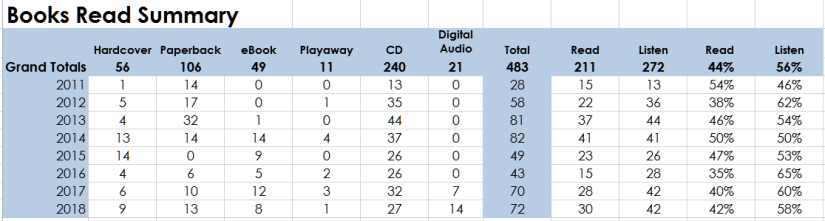
See, my work team is located around the globe, and we were mostly together this week in Toronto (thank you to those that held down the fort on the home front). As we gathered in the office, we were able to chat casually about different things more easily than on the technology we have. A few of us somehow got on the topic of getting kids started right. I related my story of how we made our kids read 100 books to earn a WII, and the conversation kept going from there. At some point, I even shared a view of the excel workbook I maintain to track my reading. We laughed and went back to our work.

That evening, we were all out at a team dinner, and sitting at a long table. The people at my end of the table included some executives that oversee the global team, new employees and internal partners. We were a diverse group. Somehow we started talking about books – I did not start this  – as my colleagues begin to tease me. Over the next hour or so they are informed that I created a dashboard of my reading history (only back to 2011) like I do for work, explain how I choose the books, where I get them, and what format I prefer and more. Aside from feeling like the largest geek there (and I will fondly state that this was not an easy title because the whole team gave me a run for my money), we had an amazing time together. The best part was getting more recommendations for expanding my reading.

With suggestions for mysteries (thank you Fifi), fantasy (thank you Allison), logic (thank you Karl) and more, my TBR list continues to expand. I am so thankful for the support of my colleagues and friends in sharing this journey with me. There are so many new things to read that I know I will never run out of suggestions, so keep them coming!

On the flight home I was able to finish the book I started on my flight there. When you were older by Catherine Ryan Hyde’s story of a man that missed being in his office at the World Trade Center on Sept 11 because he got a call that his mother died. Great book for the plane, right? The story begins in the days after, working its way back to that phone call, and then back to the aftermath. Russell’s older brother Ben needed to be looked after, as he was not able to do so himself. As the story unfolds, we are introduced to the post-traumatic stress of seeing your office collapse, watching someone jump from the towers, and knowing that only you and one other from your entire office are still alive.  Russell meets and falls in love with an Egyptian baker in his small mid-western town, and the cultures clash, while emotions run high for all. The Arabic bashing that occurs due to fear, as well as facing the reality of being responsible for his brother, brings back all kinds of stress for Russell. Ultimately, this is a story of how to come to terms with the reality of what you have gone through, and being true to yourself and your humanity. Well done, not overly morbid, but too swift and nicely packaged an ending for my taste.

Off to update my dashboard, and add to my TBR list!

dashboard

books, reading

From Riyadh to Memphis

As the world gets busy preparing for holidays, I got busy to move more books off my TBR list.  The library came through and delivered me a book to check off a country on my armchair travel list – Saudi Arabia.  Girls of Riyadh by Rajaa Alsanea, translated by Marilyn Booth was a hit in the region, and I was excited to read about life from a woman’s point of view. The book, relating the quest for love by 4 women of Saudi, is told by an unnamed person writing emails to an email group. The names of the friends were changed, but the reality of the “lives” was shared by this third person.  I admit I was expecting anything but what I got. This book was related as though the emails were sent in 2004-2005. The lives of these women, while striving for love and self worth, are complex and rich. While the society does impact who and how they can be, they all take different paths to finding themselves and their own voices. And even if you don’t like which path they took, you are faced with the undisputed fact that they did all choose their own paths.

While I was reading this story of choosing paths, I was also reading Before We Were Yours by Lisa Wingate.  In a different era, there was a horrible person that brokered babies, stealing them from poor parents and not providing safety or food properly, while doing the “good work” of finding homes for some children.  As the story is pieced together, the girls that are the focus are the “strong” ones – favorites of the fathers.  Both do their best to keep the family together, placing that above all else, until they are both faced with the fact that they need to put themselves first.  In doing so, they find a new peace.

In both cultures, across the span of time, the central characters don’t feel they have the ability to make a choice other than what their family wanted. And while the strong are the only ones left standing, the key to survival and happiness is always being true to who you are and who you want to be.

woman wearing hijab
Photo by Ambar Simpang on Pexels.com
book-review, Indigenous American, literature, reading

Stormy weather, here and in books

It was during this dark week that I finished the book Solar Storm by Linda Hogan. I have needed some time and space to process the horrifying and scary things that have occurred in the last week, as well as to process the complex story that Ms Hogan presents. As in life, this fiction has the roots of the hurt come from centuries of hate, mistrust and misunderstanding. As in fiction, hopefully life will follow; understanding, acceptance and change come next.

This is a multifaceted tale, focusing on generations of family and conflict, centered on the fictitious tribe, now known as The Fat Eaters, but truly known as The Beautiful People.  The tale begins as Angela Jensen, a 17 year old child in the foster care system, returns to stay with relatives she just discovered searching her social services file. It is here she comes to find herself, answers to the questions around the scars that mark her face, and to learn more of whom she comes from. While there she comes to know her family, her history, her gifts, and her strengths. She comes to accept herself, and her ability to adapt to the world that has changed around her, while remaining true to herself.

This book takes time to read and time to process. As the world changes slowly, the tale unfolds, one step backwards in time, then one forward. Just as the river runs on its own pace, so does the story. Similar in voice and pacing to Louise Erdrich, this seems to be a pace that is native to these tribes. Nothing is told outright, all is hinted at. You learn by listening with your heart, and seeing with new eyes.  And when the earth is to be harmed by the building of a dam, change was forced upon them. Outside intervention changes the course of the water, and impacts plants, animals and people in ways never expected.

The dam, while a fictional tale (as noted in the preface from the author) is a story that is based in truth.  In the early 1970s the Hydro-Quebec began development of a dam at James Bay on Cree and Inuit lands without permission. The hunting and fishing grounds that these tribes relied on were flooded, which resulted in mercury poisoning, entering the food chain and directly impacted these tribes.  The forced modernization that was described in the book also happened at this time. This arrogance of the company, and it’s devastating and irreversible impact on the ecosystems and the people who live on it, is shocking in its breadth and destructive power.

As the tribes band together to demand to be heard, we all need to listen. If we would only listen to the water and the earth, maybe we could all find similarities in what we learn instead of differences.  And maybe we can learn to live together in the harmony of the earth and water.

time lapse photo of stars on night
Photo by Jakub Novacek on Pexels.com
book-review, books, Family Drama, Historical Fiction, literature, reading

The Weight of Ink by Rachel Kadish

weightofink

This week I am excited to attend a new book group I was invited to.  The read, The Weight of Ink by Rachel Kadish, gives us much to talk about.  In advance of the group, I need to collect my thoughts on this complex book.

The Premise:

In the 21st century, a history professor, Helen Watt, is contacted by a former student to come examine some papers found within the walls of a centuries old home he and his wife are renovating. The professor, nearing forced retirement and struggling with Parkinson’s, sees immediately that these documents are historically important. She and her graduate student, Aaron, begin working on the documents and are faced with a rival academic with multiple graduate students being given access to the documents only a few weeks after she starts.

Intertwined within this is the story of Esther, a 17th century woman who came to England after losing her parents in a fire in Amsterdam. The Rabbi that has taken in her and her brother, having been their teacher when they were younger in Amsterdam. The Rabbi, blinded by an Inquisitor, comes to rely upon Esther as a scribe after her brother is murdered, because there was no one else. Esther, a gifted scholar in a time that does not allow for women to be one, struggles to learn more, question more, and she is considered not a “natural” woman in the standards of the day. The themes touched upon within the pages are many and nuanced.

Themes:

Sexism: First, there is the role of women in the 17th century. Esther Valasquez was provided an education with her brother in her father’s home, but was turned out of the lessons as she grew older. It was not seemly for a woman to do anything other than be a good wife.  Esther took it upon herself to listen in at the door as much as she could to continue her quest for knowledge. Much like her mother, and her grandmother, Esther’s passions placed her on a path that was not as society desired.

While not as specifically alluded to, the sexism continues in the 21st century, with Helen fighting with the men that control the money and department, as well as other male scholars that help others in the “network”. She was deliberately undermined by the head of the department, who led her to believe the papers were acquired by the university for her, but allowed for a better sourced man to come later, with more people, to put her in her academic place once again. The undertone here is that women are not supposed to be as learned as a man to this day.

Classism: Though shown more starkly to us in 17th century terms, the haves and the have nots are decidedly separated, in the streets, in the cities, and in theater. It is when these lines are crossed that problems arise. The same holds true, as noted above, about those with funding versus those without in the 21st century. It is also shown in those that own homes (having inherited from family, with treasures hidden in the walls) juxtaposed against those that rent small apartments for most of their lives.

Anti-semitism: The Amsterdam community, having been founded from survivors of the Portuguese Inquisition, was focused on ensuring their safety. They are unforgiving of anyone that questions the beliefs, simply because they are afraid that those thoughts would bring about annihilation of Judaism when the Inquisition had not succeeded. Thus, Spinoza was excommunicated.

The Nazi Camp survivors were equally concerned with their own survival. All around them continued to be dangers, including those whom would “romanticize” the world they were making without understanding the pain of which it was born. Thus the volunteers were dealt with harshly, in case they did not understand the need to do all for themselves to survive.

Expectations: The main characters, the Rabbi, Esther, Helen and Aaron all struggle with the expectations that others have placed on them and with what they have placed on themselves. The rabbi was to be a great man that would help rebuild the Jewish community in London after it became “safe” for Jews there. He knew he was not going to be able to do so – he was blinded by the eagerness to learn with Esther, so he turned a blind eye on her studying. It was not until later that Esther realizes that she has surpassed her teacher, but he had known for a longer time.  Esther struggled with expectations of being a dutiful woman, and an inquisitive scholar in a time you could not be both. Aaron struggles with a quest to be a scholar versus his parent’s expectations to be a rabbi, and Helen struggles with the expectations of love, order, and proper methods.

Names:

The Rabbi – a teacher

Esther – a biblical woman that took her place at her mother-in-law’s side after losing her husband. Where you go, I go. Your people will be my people.  Means Star in Hebrew.

Helen  – Means Light in Latin. In Greek mythology, Helen was the daughter of Zeus by Leda and the most beautiful woman in the world. The name was also a favorite of the William Shakespeare who used it two of his most well-known works, A Midsummer Night’s Dream and All’s Well That Ends Well. This was picked up by the fact that Aaron’s original dissertation was based upon Shakespeare’s Dark Lady having a Jewish background.

Aaron – In the Bible, Moses’ brother Aaron was Israel’s first high priest and is remembered for his staff which blossomed miraculously. Thus the reference to following in his father’s footsteps. Aaron is also a character in Shakespeare’s Titus Andronicus. Means Inspired in Hebrew.  This was what Aaron was missing most of the book – in the end, Helen inspired him, just as she inspired Paris in Troy, to greatness

There are many other themes and characters to explore in this book. At once intriguing and thought provoking, this is a story that will need years to be fully processed for me. The complex ideas brought forward are still being wrestled with by scholars world wide, as are the simpler ones, such as what is the meaning and reason for love.

Enjoy the book, I know I have.