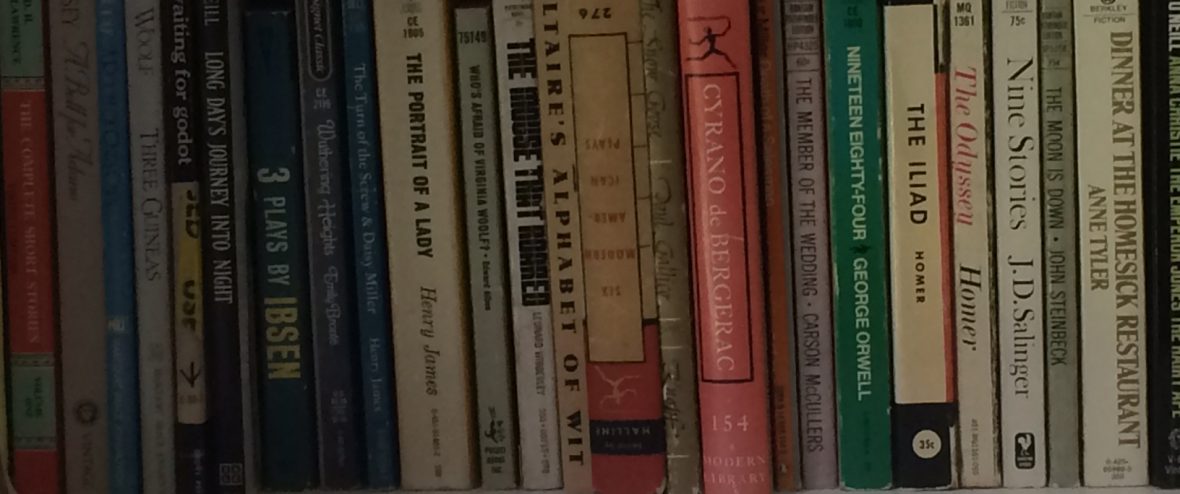
When I saw a book [An Odyssey: A father, a son and an epic] about a father taking his son’s college level seminar on the Odyssey, I was intrigued. Daniel Mendelson’s story, entwined with the epic itself, takes the opportunity to teach us parts of the classic story while mirroring what he is teaching. The poem tells you what will happen at the beginning, in the first lines of the poem. That is also done in this story. As the circles of the poem are wrapped around us, Mendelson does the same, going back and forth in time, as the epic does. It is so well done, and even though I know what happens, when I got to the end, I burst into sobs – not just tears. He had made this epic of his life, his own journey to find his father, that I was caught up with him. As I take the lessons taught in this book, I am thankful for the truth of knowing my parents. I had time with them when both my sisters were off at college. During that time we were able to forge a special relationship, able to build more adult relationships. I pray that I am able to do the same with my children. They taught me well.
Does peace have a chance?
The topic of death is as old as we are. Death can be quite, loud, soft or hard. It is especially hard when it comes in the aftermath of a battle or war. Eras are defined then by what is said about them when it is all done. The scars are deep, and as always, the artists and writers are the ones that are able to communicate the worlds of before, during and after. I have explored this before, but I return to this after I read Death is Hard Work by Khaled Khalifa.
The plot of the book is simple enough: a father dies after extracting a promise from his eldest son. That promise is that the son, known as Bolbol, will take his father to be buried in his home town, next to his sister. In normal times this would not be a large request. Difficulties abound in Damascus, where Abdel Latif died of old age amid the chaos of the dead from the Syrian civil war. Bolbol enlists his siblings, Hussein and Fatima to help. From the outset there was reluctance to do this, because it could be fatal to attempt, but they grudgingly come together. They are forced to take the body from the morgue and transport it via Hussein’s minibus because there was no other way. As the three children come together, we begin to learn their personal stories, as well as the father’s.
There are many ways to interpret the story and the characters. The body of the idealistic, harsh, and dead father is the death of the ideals of what war was based upon. The condition of the body, and the absurdity that it goes through can only be a statement on the beliefs of any group. As time wages on, the idealism falls to power grabs and pure greed, with the ideals rotting from within. The same is true of the body – and all that come near are assaulted by the smell, but let it pass. It is before it begins to decay that the military try to arrest the dead man.
The two brother’s stories were sad in that each tried their own way, and each ended up alone. One went out to find riches and power, and became a glorified runner for a gang. The other was too afraid to search for riches, so lived his life to keep others away, living in a world of his own making in his mind. Both were trying to be on their own outside the family, but being drawn back in as they got closer to Anabiya. Their sister, Fatima, was the least drawn out character. Her Aunt Layla wanted to continue to learn, but was promised in marriage instead. She warned them that she would rather set herself on fire than marry, and she did set herself aflame on the roof just before the marriage was to take place. She was buried alone and was a stain on the family’s name. Fatima came on the journey and was mistreated by Hussein, ignored when she fretted over the condition of the body, and ultimately rendered mute by the end of the journey. The statement that this makes on the journey of women is overwhelming. We have gone from being ignored of what we say and having that be a stigma on the family name, to not even being able to speak. This is underlined in the book that the closer they got to the family home, the more she was asked to cover up. So much so that Abdel Latif is ultimately not buried next to his sister because others felt she should be forgotten, even when she was not.
The concept of revenge means that the anger is never done – the blood will continue to flow. Just as the rabid dogs try to get the decaying body, those rabid followers of the ideas will never stop now that they have tasted blood.
As a statement on the possibility of peace, this story is not one that I enjoyed. It was, I believe, an indictment on the state that the Middle East, and other areas of the world. Until the need for revenge and the taste of blood is not needed, this absurdity will continue.
Catching my writing up with my reading
The last month has been a flurry of activity for me. The end of school / start of summer; building a new infrastructure at work / ensuring the work doesn’t get missed; packing, cleaning, sorting, training, and all the jumble that goes with this all.
Throughout, however, I have been reading. I haven’t made the time to write, but I have been reading. Seven books since my last post. Here they are, with some context and reactions, in order of my favorites (please note, however, I would recommend any of these):
The Golden Son by Shilpi Somaya Gowda. The story follows the eldest son of a farmer who becomes the first in his family to attend college. Anil understands he is to become a doctor, and spends his youth working toward this. As he begins his residency in Dallas, Texas, he is torn between the old world and the new. Anil needs to find his way in both medicine and in his family as his worldview has changed. Alongside this is the story of his childhood pal Leena, travelling the road to marriage as was expected. Again, expectations are not reality. At times a bit slow, but fascinating at the same time.
The Only Woman in the Room by Marie Benedict: Starting with the stage debut of Hedy Kiesler, a Jewish girl in Austria is courted and won over by a powerful arms dealer that will protect her and her family from Nazi persecution. As Hedy learns of her husband’s true nature, she flees to England, and then Hollywood. There she becomes Hedy Lamarr, screen star. Tormented by what she had witnessed in her husband’s home, she develops and patents new technology to help the war effort. This technology, was rejected by the Navy, but the patent was classified as top secret. The technology, no longer classified, is the basis of how all cell phone technology we use currently is based. To think what we owe this woman, yet she was never able to see what her work has led to. She just believed she was not able to help anyone with her knowledge.
Young Jane Young by Gabrielle Zevin: A college co-ed has an affair with the Florida congressman she has an internship with, and ends up in all the papers as “the other woman.” Her mother has not had contact with her in years. Over ten years later, Jane Young, an event planner in Maine, decides to run for mayor. This single mom has secrets that her daughter discovers, as she flees to Florida to find the answers.
The Turner House by Angela Flournoy: A black family watches as Detroit disintegrates, just as the family does. Being from Detroit, I knew of all the places that were referenced, and the history of what helped the city’s fall. The roles of the family members, the real focus of the book, are shown by different parts and times in the city’s history.
Standard Deviation by Katherine Heiny. I admit I selected this one because of the title – I am a nerd at heart. The deviation tracked within the book, however, is not what you would expect. The protagonist, Graham, is examining the differences between his first and second wives – two polar opposite personalities that he loved dearly at some point in his life. Interesting view of what we need and what we want at different points in our lives.
Call me by your name by Andre Aciman: A seventeen year old boy’s journey on discovery of himself and his sexuality. The openness of the language and passion can be overwhelming at times in its intensity. The typical first love flaws, but more connectedness than expected.
The Storm Sister by Lucinda Riley: The second in the series, this follows Ali to discover her love and her birth family in Greece and Norway.
Humanity seen through A Woman in Jerusalem by A.B. Yehoshua
A woman is killed in Jerusalem by a terrorist attack.
No one comes forward that someone was missing.
A paystub was found, and a journalist contacted the business owner to question his humanity.
The owner – in his 80s, became enraged that his humanity was questioned. He demands his Human Resource Manager find out who she was.
He is told to cancel on taking care of his daughter, as promised to his ex-wife that night. The Office Manager is sent instead.
The HR Manager goes to his office, demanding his secretary come back to the office to help find the paperwork on the person. She is forced to bring her baby, which the HR Manager cares for while she searches.
The personnel file is found. The HR Manager had written notes. She was an electrical engineer in her home country but wanted to work. She was brought on as a cleaner who requested the night shift for extra pay.
Was the task done? No. Off they march to the bakery to speak with the supervisor.
Turns out that after being accused by the secretary and questioned by the HR Manager, the initial story of her being fired but mistakenly left on the payroll was found untrue. The supervisor admits that he had lusted for this woman, who was too smart and beautiful to be near him or in this type of job. He sent her home while still being paid, so he didn’t have to be tempted by her. Thus no one realized she had not come to work, because she was not expected
When the HR Manager reports to the Owner all this, it appears that he has been told everything. He then asks the HR Manager to take the woman back to her son and mother in the old country to be buried. The trials that they go through, including almost poisoning himself to death, get him to the woman’s home town, only to be questioned why the woman had not been buried in Jerusalem where she had moved to.
The parallels to the Israeli society here are too obvious to miss. One woman unclaimed meant no one had any humanity. When investigating, they find that she was not the woman they thought she was – not just a cleaning woman but a mother, daughter, lover, and engineer. She may not have been Jewish, but the orthodox family that gave her housing also gave her a Hebrew name. And through all of these twists, it appears the old man seems to be aware of all these pieces as the HR Manager just discovers it.
The humanity of Israeli society is being questioned daily, both internally and in the press. Every person, be them Jewish or not, has a reason for wanting to be “going home” to Jerusalem, as the woman’s mother states. To assume that they would not want to die there and stay is foolhardy. We each need to cleanse ourselves fully to realize this folly – our humanity must always guide us and cannot just be apologized away. Until there is a way found back for all, we should all be questioning our humanity/
Books everyone should read
One great thing that happens when people know you are a reader is they ask for recommendations. I am always THRILLED to help people find books that they will connect with. As I have mentioned before, my co-workers think it’s funny to keep track of my target numbers, but most times they just chuckle and walk away with their heads shaking. So this week, I was over the moon when I was asked to help suggest book titles for a teen reader, and then I got THE QUESTION. What books do you say are the SHOULD BE READ BY EVERYONE? There are so many lists out there for this type of thing. Everyone has their own take on the Classics, but each of us come to these stories with life experience and beliefs that change how we react to the story as we read this at different points in our life. For example – I loved the Little House books. I have fond memories of these books and how they transported me to a different time and place when I was young. When I read them aloud to my daughter, however, I realized that the language was much more passive and I was less engaged. It was still fun to watch my daughter be transported, but I was focusing on many different aspects of the story now that I had more life experience to measure it against.
So I approached this question by only looking at the books that I have read – how can I opine on something that I have not actually read? Then the struggle over a book that I loved, but do I think that everyone should read this? Most times yes, but not always. Then I noticed that many of the books I have selected are focused on the struggles of women – such a shock because it is something I relate to! Are those all required reading for men? Many should be. So I kept paring down my list – until I reached the smallish number of 103 titles. Because – why not?
Then I set to describe why I chose the titles. After doing this, I got down to 64. I kept at it, until, after a number of times walking away, I came to the nice round number of 15. These are the titles that I currently believe everyone should read, and why.
The Red Tent by Anita Diamant
An alternative narrative to the matriarchs of the three largest religions in the world, this takes a blank story – the women’s lives are not illuminated in the Bible – and provides a full rich life for them. Sets the story of our religion on more even ground than without them. Beautifully written, completely believable.
The Poisonwood Bible by Barbara Kingsolver
Taking religion on the road, and trying to convert “savages” in their own lands takes a certain amount of arrogance and strength of will. This is the story of a man that has both in large quantities, and he takes his wife and daughters along for the ride. How he is received by the tribe he is bent to convert, and how the tribe shapes his family’s views, are a revelation in international relations, the folly of those unwilling to learn, as well as human frailty.
Fall of Giants by Ken Follet (one of a trilogy, this first was the best, in my opinion)
This is a novel that takes the intricacies of the world in the early 1900s, and explains very well how the world fell into the Great War, and the cost paid by a generation for the arrogance of men. If we don’t learn from mistakes, we are bound to repeat them. The facts are so well integrated to the story, you don’t realize how much you are learning while engaged with compelling narrative of well written characters.
Night by Eli Weisel
A first-hand account of surviving the death camps of Adolph Hitler. A slim volume that will paint a picture you will never forget. That is the point – don’t forget.
Catch-22 by Joseph Heller
Set in the middle of WWII, this is an indictment on the absurdity of war. The easily manipulated reality that is discovered when playing with those in charge. Rules are made to be broken, officers to be subverted, all in order to stay alive.
The Cellist of Sarajevo by Steven Galloway
In my last title set in war, I believe this is the most compelling and sensitive one I have read on the atrocities of war. The war here was just as savage as WWII, with ethnic cleansing a goal. You need to know about that to understand the subtleties of the writing. The goal of the cellist, and the lengths that each side will go to either stop or protect him, are an allegory for what each stands for. Never letting go of what makes us human is what will keep us all alive in the long run.
The Secret Garden by Frances Hodgson Burnett
A story of neglect and forgiveness, this traces how three children find themselves in the gardens of life, and bring to life those around them. The richness of the garden versus the starkness of the house continue to reveal more layers of depth as I grow to see the parallels to people’s lives.
Anne of Green Gables by L.M. Montgomery
When a girl shows up at the farm when they wanted a boy, she shows that while bringing different skills, they are just as important to people looking to live a full life. Dreaming can bring about both calamity and celebration, both which keep you wanting to move forward.
Alanna: The First Adventure by Tamara Pierce
With so many action adventures led by boys, it was high time a girl took over the role of Hero. In this series, launched by this first book, Alanna proves she is just as good, if not better, than the boys in their own games, and she has more to give too.
A Yellow Raft in Blue Water by Michael Dorris
The story of three Native American women, three generations of a family, and how they each experienced their own lives and challenges to make them connected. It brings each generation’s story their own voice, while seeing the difference between their reality and other’s impression of what that is.
Chronicle of a Death Foretold by Gabriel Garcia Marquez
Shorter then his typical epics, this story is what it says – the same story told from different people’s view. Each time, even though you know how it will end, you expect a different outcome. Fresh and well written, it underlines the reality that the story is in the eyes of the beholder.
The Most Beautiful Book in the World: Eight Novellas by Aric-Emmanuel Schmitt
Eight novellas, each focused on a different view of what is beauty. As with Marquez and Dorris, this is in the eye of the beholder, but this helps open them where you may have overlooked.
Wonder by R.J. Palacia
The story of children and adults that learn the lesson of being open to all – the wonder of life can be shown to you by anyone.
The Pearl by John Steinbeck
With so many of his novels being so good, I chose this one because the lesson is one that the current fame obsessed world should remember. Be careful what you ask for, it may take you further from where you want to be.
Inherit the Wind by Jerome Lawrence
A reflection on the US at a period in time, this is a fictional telling of the Scopes Monkey Trial. Thought provoking, still relevant as the struggle between faith and science continues. My favorite quote of all time comes from this: “God created man, and man returned the favor.” I used it last week.
The Hate U Give by Angie Thomas
Another reflection on the US at a period in time, this a story based upon the actual events in Ferguson. A black man is killed by a white cop. The man was unarmed, stopped at a traffic light. His friend, Starr, was in the car. How the community, police, and family react are all highlighted here with raw emotion and real conflict of doing right by your community while doing right for yourself.
Hope you enjoy them as much as I did!
A Place for Us by Fatima Farheen Mirza
A family is complex in many ways. This is a story of a Muslim couple that came to the US as newlyweds, created a family within their community and sought to pass on the things they felt were important to keeping their children safe and successful within that community.
Told from different family voices, this starts with a daughter’s wedding. Amar, the only son, has been estranged from the family, but you don’t know why at this point. The story goes through the past, with different views of the same situations they have gone through. Starting with Layla, the mother, and then going through each of the children’s stories and reactions, and ending with the father’s. Due to this being a Muslim based family, this is an interesting order. This puts the voices of women up front first, something that is unexpected due to the typical roles in that society that exist.
THE FOLLOWING CONTAINS SPOILERS TO THE STORY. PLEASE STOP IF YOU DON”T WANT TO KNOW WHAT HAPPENS BEFORE YOU READ IT – AND I SUGGEST YOU LET IT UNFOLD IN THE MANNER IT WAS WRITTEN.
The first story is Layla’s. You learn of the hardships of leaving her country to follow the man her parents selected for her to marry. She portrays herself as someone that was obedient, did as she was told, and kept to the back of the line. She details how she has grown personally, going from being afraid to be close her own drapes when her husband started to travel for work to creating a cohesive unit that functioned well without Rafiq, her husband. She speaks of the tension and fear that the children have of him, and how she kept information from him, especially about Amar. There were references to going to school to be told by the teachers that he was trouble, even held back in school because he wouldn’t do the work. He was stubborn beyond what she had ever seen, and it was worse against Rafiq. He was painting his nails with his sister, and cooking with his mother. This led me to believe he was gay and the end was going be because his father threw him out.
Haida’s story is about how she had been his best confidant. Amar had always looked to her to help him. She was the smart sister, the protector sister, the one that kept his secrets. As her story unfolds, however, it is apparent that she was in competition for her father’s attention. She was given her grandfather’s watch – something that should have been passed father to son, as it had to Rafiq. She was marrying in a love match, not an arranged marriage. She did, however, do the full Indian wedding. He was not from the community, but the parents accepted him. This led me to believe that the father was beating Amar, but he probably was not gay.
Huda, the second sister, was the one that could get him do to things. She did keep information from Amar about his secret love, undermining him in different ways. This led me to believe that there was something going on with Amar.
Amar’s story unfolds with how he was afraid of his father, struggled with his faith. He went against his community by speaking with a girl, falling in love with her. He had been smoking and drinking, but tried to give up this for her. When the girl’s parents find out, they forbid her from seeing him. The pain makes him seek anything that will take the pain away. The girl is at the wedding, and they sneak off to talk. He tells of his drug use, showing the pin prick scars from the needles. She tells Amar that his mother was the one who told her parents. A drunk Amar confronts his mother at the wedding, making a mess. This led me to believe that it was the mother that ruined things, and the father supported her.
Then the father’s story. The man that everyone was afraid of. He was orphaned at the age of 16, when his mother died, and only 13 when his father passed away. Rafiq wanted to be a good father, but was open about how many mistakes he made. He was tough on Amar, hoping to give him the motivation to strive for something to be successful, all within the community and faith he was passing down. It was Rafiq who discovered the drug needles, even though Haida had taken the drugs from him before. It was Rafiq who knew about the love affair, that didn’t put a stop to it because the thought it was good for Amar, even if he knew it would end in heartbreak. Rafiq supported his daughters to being a successful doctor and a successful teacher. He supported them that Haida selected her own husband, and Huda did also – one from within and one not from their Muslim community. This provides significant context for the family, and the “blame” game shifts significantly to the mother.
As the story kept unfolding, the complexity of who was “at fault” completely turned on its head. Each story justifies each person’s actions and reactions. With family, there is never a clear cut black and white answer to anything. Each action and statement comes with a lifetime of perceptions and experiences from the point of view of the speaker. The underlying faith throughout – that there is one G-d and that G-d is great is always there. It is that that carries us all through.
This is a story of a family, struggling to know each other’s hearts as they grow to find their own place in the world. Just like any other family in the world.
A good weekend of reading
With my work deadline met, my dinner club attended, and the laundry almost done, I have been able to catch up on some reading this weekend. While technically behind my regular pace, I remain above the majority of those that graduate and never read another book. Can’t say that I have seen the Avengers, or that I have purchased the tickets yet, but you know where my priorities are.
From Sand and Ash by Amy Harmon
This is a book about being Jewish during the Second World War in Italy. The story centers around two people that meet as children, one a boy sent from America because of his one leg, to be a priest. The other is an Italian girl whose family helped the boy and his grandparents. This improbable pair become fast friends, and grow close. The lack of belief that the Fascists would harm the Jews of Italy mirrors what happened in the rest of Europe, but the underlying negativity and Anti-Semitism of the time is glossed over. The number of “close calls” and “near misses” are very convenient, as is the theory that the Catholic Church was organized well to save Jews. I believe the truth of that was how the Pope did not intercede, in life or in fiction, to help them. As for the improbability of the ending – this was a very Hollywood ending. While it is nice to see something good come from such evil, this is the least believable part of the whole story.
My Ex Life by Stephan McCauley
The story of two formerly married people that, after a brief marriage and decades apart, are brought back together by one’s daughter. David, a gay man that had married Julia when she found she was pregnant, is contacted in San Francisco by Mandy, Julia’s teenage daughter. Mandy has brought him up to keep her divorcing parents from using her as a pawn against each other. David, who runs a successful(ish) consulting company helping the children of wealthy parents get through the college application process (no bribes here, however). He comes out to New England to help based upon Mandy’s request, and a need to leave SF as he is losing his rental to a former lover and his new partner. Julia, who has been taking hits of weed every day for years, is slightly muddled and unfocused about herself and her home, which she loves passionately, but will probably lose in the divorce. As David sets to straighten up everything (the gay man going straight line here is too obvious), and Julia allows him to take care of her, they fall into a companionable life together, as though time had not passed. While Mandy acts out on her and her mother’s lack of belief in themselves, David is the one that puts the pieces together and saves the day. But only because each person takes responsibility for their own actions, past and present, to be able to build a new future.
Next up: The Seven Sisters, A Place for Us, and The Alice Network. Someday I may finish Becoming. Right now I am bored so I am not wasting my time.
Shelter
Sometimes things just happen. This winter it has been many things. From a concussed child (cheerleading as a contact sport), a cheating scandal (who knew it is wrong to share views of your work with a “friend”?), family members with a minor stroke, a broken femur, a stay in rehab, monthly shots in the eye(s), and a brand new boss in the mix (first time with a boss in the same country in over 10 years), I have had my fair share. As I look around, however, I see myself still working toward the goals I set when I was much younger, trying to do at least as well as my parents. With college bills coming down the road fast, retirement is nowhere on the horizon. It is from this place that I began listening to Barbara Kingsolver’s Unsheltered.
This book is a combination of two stories from the same location. We start with Willa, named after the famous author, in her new house that appears to be falling down around her – literally. She receives a call from her son, a brand new father, to say that his partner, Helene had just committed suicide. Their son had been in the bassinet, and was crying like crazy, which is what made Zeke go look in on Helene. A funeral is made, bags are packed – the house, the car, and the credit card debt all belonged in Helene’s name. Zeke made a pilgrimage to his parent’s home in Vineland with his newborn infant and staggering student debt. He joins his parents, Willa and Yanno, his sister Tig, and Yanno’s father Nick. Nick is an immigrant from Greece who rails against everyone who is not white or has the same beliefs as he does. He is diabetic, on oxygen, and nearing the end of his life. Yanno had spent years working toward tenure, but never achieving it. The family had been moving down the rankings at colleges in search of this elusive ticket to a future, security, and an ability to say they succeeded. Tig, who had left the family and come back after a clandestine stay in Cuba, was forever bucking the staunch economic grab of father political scientist and brother economist. She was the scientist that looked at what was there and did not expect more.
In the earlier era, Thatcher brings his wife, sister in law, Polly and their mother back to Vineland after being cast off when their father died and left them penniless in Boston at the mercy of a relative. Thatcher Goodnow brought them back to the house they loved. That house, designed and built by their father, was falling down around them. Thatcher, hired as a high school science teacher, was not wealthy, as his wife’s family had been at one time. With the return to the family home, the ladies began to act that way again. Thatcher saw no way to support these ways, and was fearful he would need to make them leave again. He was at odds with the school’s principal and the town’s founding father Landry about the theory of evolution. Thatcher’s neighbor, Mary Treat, was a scientist. She was in contact with Charles Darwin and other prominent scientists of the day. It was the connection between Thatcher and Mary that helped him understand what was important and what he valued.
This was where things all join. The two stories are about being open to observing that changes are happening, if you want them to or not. You need to examine what it means, and how you should adapt. It is those that adapt that will survive. Do with what you have, enjoy those around you, and know when it is good to retreat.
When Giants Fall – Re-examining a favorite author
Since I read the Nick Adams stories, way back in high school, I have been a fan of Hemingway’s writing. I do admit that I felt a connection, since Horton’s Bay is somewhere I used to walk to on rainy days from my camp on Lake Charlevoix – I had been told that the camp’s property was next to that of Hemingway’s. In college I discovered In Our Times, The Sun Also Rises, and A Farewell to Arms. He became my favorite writer, and I discovered my father’s favorite too. I reveled in the crisp, clear sentences, the Code, and the adventure. Then “people” started questioning why I would like the writing of a sexist man, especially since I am a staunch feminist? The answer, I found, was as complicated as the author.
In my college years, and many before and after, I clung to the Code that Hemingway had laid out for a Real Man. This code, in my view, is that a person must be strong, embrace life wholly, be open to all possibilities, and always be true to themselves. That meant savoring each bite, drinking the last drop, and being with the person you like right now. The crazy thing I saw missing from my critic’s view was that in The Sun Also Rises, Brett lived this code perfectly. She did as she pleased regardless of convention. This is why I had loved this book better than the critic’s favorite For Whom the Bell Tolls. Maria’s passiveness and awakening only with Robert near her seemed simpering to me.
Then I was awakened myself. I read The Paris Wife, a fictional account of Hemingway’s first marriage. The references to Sherwood Anderson, and others whom were cast off later by “Papa” made me curious. I took to my father’s bookshelf and snagged Winesberg, Ohio. Sure enough, the loosely connected stories were crisp and clear, with a code of their own. Written well before In Our Time. And I concluded that each of Hemingway’s best works were written when starting a new relationship with a woman that lived his hero’s code better than he did.
Yesterday, when I was reporting my completed reading to my goodreads.com challenge group, I saw that someone was reading Winesberg, Ohio. After I mentioned that it would make her question Hemingway’s genius, someone shared with me the link to Ellen N. La Motte’s The Backwash of War. It seems that the model of writing Hemingway laid claim to developing was actually from both Anderson and La Motte. La Motte’s book has been made available from the Guttenberg Project, and is accessible free of charge from libraries and amazon. I have just downloaded this, and I am now entering into an uncomfortable place where I need to rethink my reactions to the writing of Hemingway even more deeply. Even if uncomfortable, I will put myself into action (code requirement), be true to myself (code requirement) and decide what I must without looking back (code requirement.)
I will let you know what happens…..
We were on a break….
Being in a book group can be good and bad. Sometimes you end up reading books you would never pick up, and end up having a whole new world opened to you. Other times you drag your way through a book simply to say you read it when you meet up with the group. I have been excitedly working through the Goodreads “play book tag” challenges, but this year I seem to have hit the wall. The Trim the Books challenge has selected my random books that I have not loved, and this month’s I will not finish. I just can’t bring myself to read another story about a couple that has lost a child. I just can’t.
So I took a break from read. It is now March 15, and I have only read 8 books so far this year. I am way behind my pace from last year of 1.5 books a week. I may not make the total books challenge I made, but I am reminding myself that the challenge was made by me, for me and there is no reason to make reading into a chore.
So after 2 weeks of no reading at all – not even listening in my car – I have returned to the world of books. I am listening to Pachinko. At about halfway through, I am fascinated with the descriptions of how Koreans were treated by the Japanese, and about how the country was torn in two after the second world war. It helps put what is happening currently between these two factions into context. It also highlights for me just how easy it is for a group to be marginalized and vilified. I am looking forward to finishing this one, and getting a fresh start soon on the next group of titles that will hopefully draw me back into the written word.
 The Source 4 Books
You must be logged in to post a comment.