book-review, books, literature, reading

death with a small “d”

I have been struggling to complete a book, Death with Interruptions by Jose Santiago, that had sounded amazing to me. The description on the dust cover was compelling me to read this book. Yet, whenever I picked up the book, I dreaded moving forward. The story plodded along, the structure was where basic punctuation was not included. Paragraphs were pages long. Dialogue was not distinguished between people. The book lulls you into a state everything is expected, yet nothing is.  It is in this manner that the book discusses how death (with a small d) decides not to work after the New Year begins.

At first, everyone is surprised, happy even, to have beaten death at her own game. They celebrate until they realize the consequences. First the funeral directors, then hospitals and assisted living facilities, Insurance companies and even the church, all struggle to find meaning for themselves in this strange world. Families are left watching those they love suffer indefinitely. They can bear it no longer, and neither can those that suffer. A way to put the balance of life back in order is found. Profiteers abound to take over and the money cycle, just like the life cycle, begins again.  As the country adjusts to a new “normal” death again steps in. A letter, on violet stationary, is received by a minister of government, and the contents are announced on television. Every person going forward will receive a letter one week in advance to allow them to settle affairs. This continues until a letter is returned, not once but twice to death.

As she explores the reasons why this would happen, as never before had death’s call been challenged in such a way, she begins to follow the cellist the card was meant for. She takes human form and presents herself to him. In the end, she stays in his embrace.

The metaphor this provides is overwhelming. The more we change the order of life, the expectations of life, the more the world works to change it back. Yet, at its core, this is a story of a need for connected-ness. How to connect a family instead of tearing it apart with death. How to allow for closure before dying. How to embrace life before letting go.

So glad I finished this. It was just hard to do. Just like life.
skull-reaper-linocut-illustration

book-review, books, Indigenous American, literature, reading

Refugee Problems in 1988 – the Kingsolver way

The first Barbara Kingsolver book I read was The Poisonwood Bible. It was soon after the release. Since then I have been reading as many of her books as I can. She is a storyteller extraordinaire.  As I was looking at my 50 States challenge, I realized I didn’t have a book for Arizona, and fell upon The Bean Trees.  One of her earlier books, this one focuses on a young woman that leaves the poverty of Kentucky to find her way in the world. She jumps in a car that is broken down, but moving, and heads west. As she goes through Oklahoma, she finds herself on Cherokee land. Here, she is faced with true need, and her fate is handed to her, literally.

As she continues her journey, she witnesses the worst that the world can be to others – especially children – and yet she remains surprised with each revelation. Her car finally gives out in Arizona, and she finds her way through the kindness of strangers. These people become her family, her home, and she comes to terms with the understanding that she was a refugee from Kentucky looking for a better life, just as refugees from other countries come to the US for another chance. Each has their past, but each also looks to the future with hope. The bean trees growing in Maddie’s back yard take root where they are, even though they came from so far away. Just like the people who tend them.

With the immigration issues still as difficult now as when the book was published, the story remains as relevant today as it did in 1988.  With this, and Letters from a Woman Homesteader, I can fill in Arizona and Wyoming on my 50 states list under the At Home Travel Log. And I will keep looking for more of Kingsolver’s books. I have never been disappointed.

aged aging background bark
Photo by Fancycrave.com on Pexels.com
book-review, books, literature, reading

Off to a Slow Start

The polar vortex may only be headed my way right now, but my brain appears to be frozen. While I may seem to be off to a good start of my new reading goals, I am not spending the time doing the actual reading lately. I have all these books checked out of the library, and I have picked them up and opened them, but for some reason I don’t understand, I am struggling to dive in.

My current theory is that the new ice age that seems to be starting is what is paralyzing me.

Not really, but maybe?

Sometimes, even if you are a big reader, you just need some time to be you. I notice that when I dive into a book, just like the water, I become immersed within the people and place. I put the book down reluctantly. The feelings and sensations that are tied to the book come with me – and not everyone around me understands because they had not been on that journey with me only 2 minutes ago, even if I was sitting next to them.

It is in this frame of mind that I listened to Autumn by Ali Smith. This story is a combination of memories and dreams of the main characters. Childhood for Elisabeth was greatly influenced by her neighbor, Daniel. She spent many hours with him as an “unpaid babysitter” after moving in when she was 10. He helps her see the world through new eyes. Each time he greeted her, he asked what she had been reading lately. He also played a game of describing art to her with words. She went on to study art at University and ended up writing her dissertation on the artist’s work that Daniel had described to her as a child. Throughout the story, Elisabeth is sitting by the bed as Daniel is unconscious near the end of his life. As her mother enjoys a newfound life, and Elisabeth is asked to face what her next step is, the concept of what is love is explored – between friends, across ages, regardless of gender. How you approach your life at each stage is important. Knowing what book you are reading – even if you are just thinking about it, opens all sort of new worlds to you. If you only let it.

architecture buildings business city
Photo by Aleksandar Pasaric on Pexels.com
book-review, books, Family Drama, memoir, Non-Fiction, reading

Educated: a memoir of survival

Tara is a child that has defied all sorts of odds to get to where she is today. She has survived a bi-polar father, a subservient wife, a violent brother, and all kinds of wounds both physical and psychological.

While I understand that there are groups of people that resist the government at all costs, it is always amazing to me that they do so by keeping those around them ignorant. No TV, no books, no contact with outsiders. This keeps those around the charismatic leader dependent upon them for any information. This is the typical manner that the male establishment has maintained control over women. This establishment includes religious establishment.

It is not surprising that when Tara earns a scholarship to Cambridge, she begins to read the foundational Mormon texts differently. As with many other religious texts, the undercurrent of a woman’s place in the home is strong. The weapon of ignorance continues today to be wielded against women from here to the Middle East and back. When women have no other information or source, the history they know is only the one told by the man. And we all know, history is shaped by the winner.  By creating the history, there is only one future for women in the world.
Throughout the story of her childhood and growing awareness of the world, we hear how her father decided her mother should be a mid-wife, even though she was terrified. How her father decided they were leaving Utah in the middle of the night in a snow storm, ending in a car wreck that almost killed the entire family. How her father put her brother on a beam that he dropped approximately 12 feet from, sat him up and went back to work. All his many children were scared of him and the end of the world he kept predicting.  The family had weapons, fuel and food to last many years when the world was to end at Y2K, and were sure the Feds were going to kill them like they did the Weavers. All history and facts came through her father.

As Tara begins to experience the outside world, she learns facts and history she never knew. The Holocaust, Civil Rights Movement, and the story of Ruby Ridge, where the Weavers were killed. All were either new to her or new details were revealed that showed the original information to be false.

She is conflicted with wanting something else while still wanting the familiar. The fact that the root of the word is family is not coincidental. As she begins to read, to work, and to learn she begins living separate lives, keeping them away from each other. She cannot reconcile the two. At one point she wonders if she had become too educated to be part of her family. Ultimately the cost of learning and becoming a Phd was her family. With the majority of the family economically dependent upon the parents, they are able to keep them doing as the father wants. Other siblings that have been able to leave and educate themselves, also Phds, are on the outside.

The thing that causes the great rift is that she speaks out about her brother’s physical abuse to her and her sister. She did so in support of her sister, Audrey. The cost to Audrey was too high – to be cut off from her economic support (both she and her husband worked for her father) and to be cast out of the family while living minutes from them was too dear to pay.

Throughout the story of her life there are moments where she is told to stay in the kitchen where she belongs, that she should not tempt men, and that she deserved to be beaten, that she was not dating as commanded by the Mormon Church. These conflicts will remain with her always. The ultimate price to pay for being your own person in this family is to be cast out. Tara was lucky that so many were cast out she was able to go to her aunt and state she would ignore what her father claimed of the aunt if the favor was returned. That family – previously lost to her – is what sustains her now.

In the face of so many obstacles, her ability to survive on her own terms is the legacy the family gave her. A brave woman, stronger than even she knows.

close up of woman working
Photo by Pixabay on Pexels.com
books, reading

Back at it – 2019 has begun

Ending the year 2018 with a big historical biography has slowed me down. While it was an amazing book, Clara Barton was a complex individual with a spine of steel, and a depth I had not fully appreciated prior to reading this biography, the dense volume took much time to digest. I ended up taking the last week off before year end with no reading at all. All in all, the year of 2018 was a successful reading one for me. 2019 is looking to be another one.

This year I am continuing with the reading challenges that I found last year. These are right up my alley – one is reading about different cultures – and I am excited to see what I am going to mark off my personal around the world book challenge. The first challenge to be tackled by me, however, is from my TBR list – The Bookshop of Yesterdays.

The main character is named for Miranda in Shakespeare’s The Tempest, and the bookstore she inherits is Prospero Books. The story begins when Miranda hears that her Uncle Billy, whom she has not seen or heard from in 16 years, has died. Billy was known for his scavenger hunts – and he sent one to Miranda after his death. She returns from Philadelphia to California to find out what happened. Throughout the story, the mystery of why Billy disappeared on her 12th birthday is driving her forward to reveal the secrets her parents have kept from her. The parallels to The Tempest abound through the book, and I am sure I would have noticed more if I had actually read Shakespeare’s story. If you are familiar with the book, you will solve this much quicker than if you do not. Either way, the characters are engaging, if playing according to the rules of the original. All in all, this was a good read.


books, humor, reading

My Christmas morning

Twas the morning of Christmas, and all through the house

Not at creature was stirring, I hope there’s no mouse

I woke with a start, I started to panic

Did I do this or that, or did I just jam it?

So I crept down the stairs, quite as can be

To do more puzzles, a quiz, but nothing before coffee

The puppy remains upstairs in her bed,

With visions of car keys dancing in my girl’s head

The boy is out cold, with a clicker in hand

As he tries to win best fortnighter in the land

We unplugged last night to play Monopoly

When hubby and I ended our spending spree

All is peaceful for now, with everyone out

So soon they will wake and begin to shout

Today is the day when nothing is open

You know that means they need something this moment

With a mug in one hand, and a wish in my heart

That I remembered my glasses so I could read the next part

So I move to the keyboard, enlarging the font,

Wondering what next they will want

I write down my saga, however so sad

That I cant read without glasses – and that makes me mad

I can’t go back up and wake up my hubby

Or the dog will start barking and then in a hurry

They all will be up, my peace will be gone

The chores will begin and I’ll be forlorn

For these hours I cherish – you’ll find me if you look

Curled up on the couch, reading a new favorite book.

Merry Holidays to all!

books, reading

Thankfulness, over San Luis Rey

In the United States, this was a week to be Thankful.  With so much going on in the world today, it is good that we stop and look to see where we have come from.

This is the case when a Brother Juniper, a Franciscan monk, witnesses The Bridge of San Luis Rey collapse in 1714, killing 5 people but saving himself from crossing at that exact moment. Believing his escape was based upon Divine Intervention of God, Brother Juniper strives to capture the fullness of each person’s lives that were lost to prove that he was saved by God. In doing this, he examines the relationship and choices of these individuals, one at a time.  The first to be examined is Doña María, the Marquesa de Montemayor. An old woman, described as ugly, is estranged and distant from her daughter, Clara, in Spain. Letters were the only way these two women could communicate to each other, because of the distance in spirit and in proximity.  Doña Maria takes on a companion, Pepita, who is not happy with her new role. She writes to the Abbess, from the convent she was at when chosen as a companion, of how miserable she is. Dona Maria finds this, and realizes that Pepita is brave in a way she is not, and the letters to Clara become more polished, so much so that they are studied in schools centuries later.

Estaban and Manuel, twins at the same convent that Pepita was at, also had a close relationship with the Abbess. She helped raise them, teaching them to be scribes, which led Manuel to meet and fall in love with Camila Perichole. Manuel, however, is cut on his leg, and while Estaban is following directions to clean it hourly, the pain makes Manuel curse his brother. After he dies from the infection, when asked which he was, he answered Manuel. The guilt and loss make him do crazy things, such as trying to kill himself. While he was not successful, he was on his way to buy a present for the Abbess when the bridge collapsed.

Lastly, Uncle Pio and Jamie, the confidant and son respectively of Camila Perichole, come down from the place she has hidden herself away after being scared by smallpox. Uncle Pio had hoped to bring the boy back to the world and prepare him for a future away from his mother.

As Brother Juniper examines each, ultimately making a “scorecard” for the souls that were lost.  He comes to no conclusion, but faithfully put his account to paper. It is found to be heresy, and both the book and the Franciscan are burned.

After the funerals for those that had fallen, Camila Perichole seeks out the Abbess to see how she can live without Uncle Pio and Jamie. She becomes a helper for the Abbess as she begins to let go of her grand hopes for continuity. Clara also returns and works with the Abbess.  The novel ends with the Abbess’s observation: “There is a land of the living and a land of the dead and the bridge is love, the only survival, the only meaning.”

So on this thanksgiving weekend, the only meaning that remains is Love.

books, reading

The true self in life and in books

I spent this last week traveling for work, and I have not been away from the family that long ever. Happily, I returned to a standing home, with three humans happy to see me, and one dog that couldn’t lick me enough. I didn’t even see the dirty dishes and laundry that was waiting for me…..all week.  It is nice to be loved.

When I travel for work, there is a great opportunity for me to get some good reading in with little interruption, especially on a plane or in the hotel at night. This trip, while a long one, did not provide me with as much reading time as I expected, but it did provide my colleagues with much merriment at my passion for books.

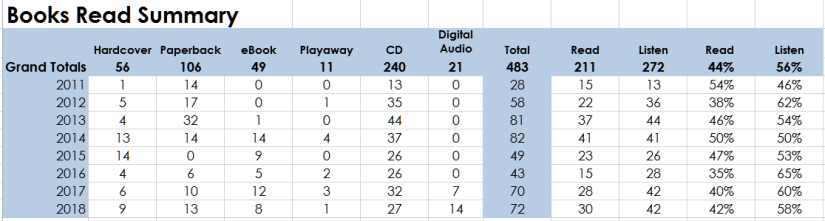
See, my work team is located around the globe, and we were mostly together this week in Toronto (thank you to those that held down the fort on the home front). As we gathered in the office, we were able to chat casually about different things more easily than on the technology we have. A few of us somehow got on the topic of getting kids started right. I related my story of how we made our kids read 100 books to earn a WII, and the conversation kept going from there. At some point, I even shared a view of the excel workbook I maintain to track my reading. We laughed and went back to our work.

That evening, we were all out at a team dinner, and sitting at a long table. The people at my end of the table included some executives that oversee the global team, new employees and internal partners. We were a diverse group. Somehow we started talking about books – I did not start this  – as my colleagues begin to tease me. Over the next hour or so they are informed that I created a dashboard of my reading history (only back to 2011) like I do for work, explain how I choose the books, where I get them, and what format I prefer and more. Aside from feeling like the largest geek there (and I will fondly state that this was not an easy title because the whole team gave me a run for my money), we had an amazing time together. The best part was getting more recommendations for expanding my reading.

With suggestions for mysteries (thank you Fifi), fantasy (thank you Allison), logic (thank you Karl) and more, my TBR list continues to expand. I am so thankful for the support of my colleagues and friends in sharing this journey with me. There are so many new things to read that I know I will never run out of suggestions, so keep them coming!

On the flight home I was able to finish the book I started on my flight there. When you were older by Catherine Ryan Hyde’s story of a man that missed being in his office at the World Trade Center on Sept 11 because he got a call that his mother died. Great book for the plane, right? The story begins in the days after, working its way back to that phone call, and then back to the aftermath. Russell’s older brother Ben needed to be looked after, as he was not able to do so himself. As the story unfolds, we are introduced to the post-traumatic stress of seeing your office collapse, watching someone jump from the towers, and knowing that only you and one other from your entire office are still alive.  Russell meets and falls in love with an Egyptian baker in his small mid-western town, and the cultures clash, while emotions run high for all. The Arabic bashing that occurs due to fear, as well as facing the reality of being responsible for his brother, brings back all kinds of stress for Russell. Ultimately, this is a story of how to come to terms with the reality of what you have gone through, and being true to yourself and your humanity. Well done, not overly morbid, but too swift and nicely packaged an ending for my taste.

Off to update my dashboard, and add to my TBR list!

dashboard

book-review, Indigenous American, literature, reading

Stormy weather, here and in books

It was during this dark week that I finished the book Solar Storm by Linda Hogan. I have needed some time and space to process the horrifying and scary things that have occurred in the last week, as well as to process the complex story that Ms Hogan presents. As in life, this fiction has the roots of the hurt come from centuries of hate, mistrust and misunderstanding. As in fiction, hopefully life will follow; understanding, acceptance and change come next.

This is a multifaceted tale, focusing on generations of family and conflict, centered on the fictitious tribe, now known as The Fat Eaters, but truly known as The Beautiful People.  The tale begins as Angela Jensen, a 17 year old child in the foster care system, returns to stay with relatives she just discovered searching her social services file. It is here she comes to find herself, answers to the questions around the scars that mark her face, and to learn more of whom she comes from. While there she comes to know her family, her history, her gifts, and her strengths. She comes to accept herself, and her ability to adapt to the world that has changed around her, while remaining true to herself.

This book takes time to read and time to process. As the world changes slowly, the tale unfolds, one step backwards in time, then one forward. Just as the river runs on its own pace, so does the story. Similar in voice and pacing to Louise Erdrich, this seems to be a pace that is native to these tribes. Nothing is told outright, all is hinted at. You learn by listening with your heart, and seeing with new eyes.  And when the earth is to be harmed by the building of a dam, change was forced upon them. Outside intervention changes the course of the water, and impacts plants, animals and people in ways never expected.

The dam, while a fictional tale (as noted in the preface from the author) is a story that is based in truth.  In the early 1970s the Hydro-Quebec began development of a dam at James Bay on Cree and Inuit lands without permission. The hunting and fishing grounds that these tribes relied on were flooded, which resulted in mercury poisoning, entering the food chain and directly impacted these tribes.  The forced modernization that was described in the book also happened at this time. This arrogance of the company, and it’s devastating and irreversible impact on the ecosystems and the people who live on it, is shocking in its breadth and destructive power.

As the tribes band together to demand to be heard, we all need to listen. If we would only listen to the water and the earth, maybe we could all find similarities in what we learn instead of differences.  And maybe we can learn to live together in the harmony of the earth and water.

time lapse photo of stars on night
Photo by Jakub Novacek on Pexels.com
books, reading

Finding Oneself in Paris

eiffel tower during daytime
Photo by Pixabay on Pexels.com


When I am between books, typically as I wait for my next title to arrive at my library for me to read, I search the stacks for authors that are familiar to me.  That is how I stumbled upon The Little French Bistro by Nina George. Ms. George had captivated me in The Little Paris Bookshop, with the book seller matching books to help people solve life’s questions.  The Bistro, as the Bookshop, is full of older characters, wise in many ways, but foolish in others.  Marianne, a sixty year old German woman, tries to kill herself when on vacation with her husband of 41 years by jumping into the Seine after she wandered away from a tour with no one noticing. She is saved by street people and taken to a hospital. Here she sees a painting of the coast of Brittany and is compelled to go there. She begins her journey with nothing but what she had upon leaving the hospital. Along the way she is both helped by, and helps, nuns, chefs, fishermen, artists and more. As these people are drawn to her open and caring being, she is being introduced to herself in the same way.

She starts the journey with a wish for death, her life is dragging her so low. She has given up music, driving, work and more, one thing at a time, as she makes her way through her 41 years of marriage. She allows her world to be narrowed and defined by a husband that is absent in emotional and physical ways. She wishes she had children, but does not seem to have an explanation for not, other than saying her husband was unfaithful and didn’t give her pleasure.

As each day in Brittany begins, Marianne takes a walk to the water at the End of the World, what Brittany is known. It is from there that she finds pathways to new friends, like Pascal, where she is able to use her knowledge of having volunteered with seniors before.  As she meets each new person, and savors each new experience, she opens herself up to a bit more of who she wants to be. At her wedding, her father saw that the groom never asked her to dance, and asked if she was happy. This lost opportunity to express her desires and needs passed, and continued to pass, until she learned to start again in Brittany.

A lesson in knowing you have a responsibility to speak up for what you want, it also acknowledges how things can go wrong when you think you know the answers. As long as you are open with yourself, and those around you, happiness will be there for you.