book-review, books, Family Drama, memoir, Non-Fiction, reading

Educated: a memoir of survival

Tara is a child that has defied all sorts of odds to get to where she is today. She has survived a bi-polar father, a subservient wife, a violent brother, and all kinds of wounds both physical and psychological.

While I understand that there are groups of people that resist the government at all costs, it is always amazing to me that they do so by keeping those around them ignorant. No TV, no books, no contact with outsiders. This keeps those around the charismatic leader dependent upon them for any information. This is the typical manner that the male establishment has maintained control over women. This establishment includes religious establishment.

It is not surprising that when Tara earns a scholarship to Cambridge, she begins to read the foundational Mormon texts differently. As with many other religious texts, the undercurrent of a woman’s place in the home is strong. The weapon of ignorance continues today to be wielded against women from here to the Middle East and back. When women have no other information or source, the history they know is only the one told by the man. And we all know, history is shaped by the winner.  By creating the history, there is only one future for women in the world.
Throughout the story of her childhood and growing awareness of the world, we hear how her father decided her mother should be a mid-wife, even though she was terrified. How her father decided they were leaving Utah in the middle of the night in a snow storm, ending in a car wreck that almost killed the entire family. How her father put her brother on a beam that he dropped approximately 12 feet from, sat him up and went back to work. All his many children were scared of him and the end of the world he kept predicting.  The family had weapons, fuel and food to last many years when the world was to end at Y2K, and were sure the Feds were going to kill them like they did the Weavers. All history and facts came through her father.

As Tara begins to experience the outside world, she learns facts and history she never knew. The Holocaust, Civil Rights Movement, and the story of Ruby Ridge, where the Weavers were killed. All were either new to her or new details were revealed that showed the original information to be false.

She is conflicted with wanting something else while still wanting the familiar. The fact that the root of the word is family is not coincidental. As she begins to read, to work, and to learn she begins living separate lives, keeping them away from each other. She cannot reconcile the two. At one point she wonders if she had become too educated to be part of her family. Ultimately the cost of learning and becoming a Phd was her family. With the majority of the family economically dependent upon the parents, they are able to keep them doing as the father wants. Other siblings that have been able to leave and educate themselves, also Phds, are on the outside.

The thing that causes the great rift is that she speaks out about her brother’s physical abuse to her and her sister. She did so in support of her sister, Audrey. The cost to Audrey was too high – to be cut off from her economic support (both she and her husband worked for her father) and to be cast out of the family while living minutes from them was too dear to pay.

Throughout the story of her life there are moments where she is told to stay in the kitchen where she belongs, that she should not tempt men, and that she deserved to be beaten, that she was not dating as commanded by the Mormon Church. These conflicts will remain with her always. The ultimate price to pay for being your own person in this family is to be cast out. Tara was lucky that so many were cast out she was able to go to her aunt and state she would ignore what her father claimed of the aunt if the favor was returned. That family – previously lost to her – is what sustains her now.

In the face of so many obstacles, her ability to survive on her own terms is the legacy the family gave her. A brave woman, stronger than even she knows.

close up of woman working
Photo by Pixabay on Pexels.com
book-review, books, Family Drama, Historical Fiction, literature, reading

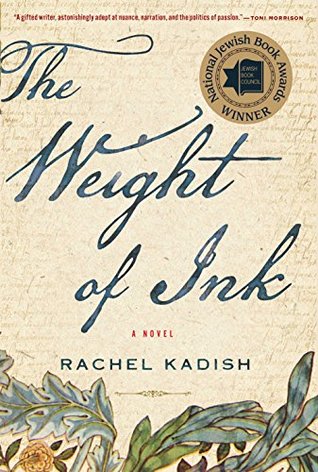
The Weight of Ink by Rachel Kadish

weightofink

This week I am excited to attend a new book group I was invited to.  The read, The Weight of Ink by Rachel Kadish, gives us much to talk about.  In advance of the group, I need to collect my thoughts on this complex book.

The Premise:

In the 21st century, a history professor, Helen Watt, is contacted by a former student to come examine some papers found within the walls of a centuries old home he and his wife are renovating. The professor, nearing forced retirement and struggling with Parkinson’s, sees immediately that these documents are historically important. She and her graduate student, Aaron, begin working on the documents and are faced with a rival academic with multiple graduate students being given access to the documents only a few weeks after she starts.

Intertwined within this is the story of Esther, a 17th century woman who came to England after losing her parents in a fire in Amsterdam. The Rabbi that has taken in her and her brother, having been their teacher when they were younger in Amsterdam. The Rabbi, blinded by an Inquisitor, comes to rely upon Esther as a scribe after her brother is murdered, because there was no one else. Esther, a gifted scholar in a time that does not allow for women to be one, struggles to learn more, question more, and she is considered not a “natural” woman in the standards of the day. The themes touched upon within the pages are many and nuanced.

Themes:

Sexism: First, there is the role of women in the 17th century. Esther Valasquez was provided an education with her brother in her father’s home, but was turned out of the lessons as she grew older. It was not seemly for a woman to do anything other than be a good wife.  Esther took it upon herself to listen in at the door as much as she could to continue her quest for knowledge. Much like her mother, and her grandmother, Esther’s passions placed her on a path that was not as society desired.

While not as specifically alluded to, the sexism continues in the 21st century, with Helen fighting with the men that control the money and department, as well as other male scholars that help others in the “network”. She was deliberately undermined by the head of the department, who led her to believe the papers were acquired by the university for her, but allowed for a better sourced man to come later, with more people, to put her in her academic place once again. The undertone here is that women are not supposed to be as learned as a man to this day.

Classism: Though shown more starkly to us in 17th century terms, the haves and the have nots are decidedly separated, in the streets, in the cities, and in theater. It is when these lines are crossed that problems arise. The same holds true, as noted above, about those with funding versus those without in the 21st century. It is also shown in those that own homes (having inherited from family, with treasures hidden in the walls) juxtaposed against those that rent small apartments for most of their lives.

Anti-semitism: The Amsterdam community, having been founded from survivors of the Portuguese Inquisition, was focused on ensuring their safety. They are unforgiving of anyone that questions the beliefs, simply because they are afraid that those thoughts would bring about annihilation of Judaism when the Inquisition had not succeeded. Thus, Spinoza was excommunicated.

The Nazi Camp survivors were equally concerned with their own survival. All around them continued to be dangers, including those whom would “romanticize” the world they were making without understanding the pain of which it was born. Thus the volunteers were dealt with harshly, in case they did not understand the need to do all for themselves to survive.

Expectations: The main characters, the Rabbi, Esther, Helen and Aaron all struggle with the expectations that others have placed on them and with what they have placed on themselves. The rabbi was to be a great man that would help rebuild the Jewish community in London after it became “safe” for Jews there. He knew he was not going to be able to do so – he was blinded by the eagerness to learn with Esther, so he turned a blind eye on her studying. It was not until later that Esther realizes that she has surpassed her teacher, but he had known for a longer time.  Esther struggled with expectations of being a dutiful woman, and an inquisitive scholar in a time you could not be both. Aaron struggles with a quest to be a scholar versus his parent’s expectations to be a rabbi, and Helen struggles with the expectations of love, order, and proper methods.

Names:

The Rabbi – a teacher

Esther – a biblical woman that took her place at her mother-in-law’s side after losing her husband. Where you go, I go. Your people will be my people.  Means Star in Hebrew.

Helen  – Means Light in Latin. In Greek mythology, Helen was the daughter of Zeus by Leda and the most beautiful woman in the world. The name was also a favorite of the William Shakespeare who used it two of his most well-known works, A Midsummer Night’s Dream and All’s Well That Ends Well. This was picked up by the fact that Aaron’s original dissertation was based upon Shakespeare’s Dark Lady having a Jewish background.

Aaron – In the Bible, Moses’ brother Aaron was Israel’s first high priest and is remembered for his staff which blossomed miraculously. Thus the reference to following in his father’s footsteps. Aaron is also a character in Shakespeare’s Titus Andronicus. Means Inspired in Hebrew.  This was what Aaron was missing most of the book – in the end, Helen inspired him, just as she inspired Paris in Troy, to greatness

There are many other themes and characters to explore in this book. At once intriguing and thought provoking, this is a story that will need years to be fully processed for me. The complex ideas brought forward are still being wrestled with by scholars world wide, as are the simpler ones, such as what is the meaning and reason for love.

Enjoy the book, I know I have.

book-review, books, Family Drama, literature, reading

Eleanor Oliphant has been here

A typical crisis for me is there are too many book to choose from. After picking book group titles last week, I had to read another title I proposed that others had already read.  Eleanor Oliphant is Completely Fine, by Gail Honeyman, was a joy.

At times reminiscent of The Rosie Project or A Man Called Ove, this fish out of water story had a bit of a dark twist.  While stumbling into real life, Eleanor is forced to face her past instead of drowning it in vodka. She begins to plan for a life with a man she has never met. As she executes this plan, she begins “self improvement” with a new haircut, new clothes, and new makeup. Outside of this plan, however, are interactions with people in ways she is unfamiliar with. Raymond, the tech support at her office, and Sammy, the person they helped when in distress on the street, provide her with more support than she knew she needed.

In fact, when she first met Raymond he found a virus on her computer and was able to clean it so it would be more effective. Same could be said of how he helped Eleanor. There were people to help around her always, she just needed to have some programs tweaked to have her work effectively with them. Another metaphor in the story is how she sets to cleaning her apartment. It transforms from a sad, uncared for space into a bright space looking for interesting things to add to the walls. She was a sad, uncared for person (she thought), but when she cared enough to buy herself things more than “useful” she is no longer just her scars, but a beautiful woman.

And while the dark part of the story was not hard to guess at due to the clues, the fact that she had so successfully fallen through the cracks of the system that was to help her was a sad comment on those the legal system that is meant to protect children.